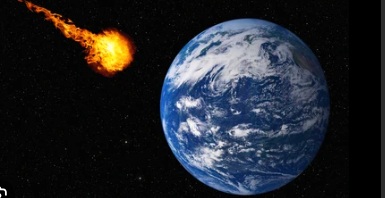
Recent news reports have been abuzz with the possibility that an asteroid, designated 2024_YR4, may collide with Earth in December 2032. Our planet is frequently struck by celestial bodies. For example, 65 million years ago, an asteroid about 6 miles in size struck the Gulf of Mexico, with a power approximately 4.5 billion times that of the Hiroshima atomic bomb, creating a crater about 124 miles deep near the Yucatan Peninsula. The resulting catastrophe caused drastic climate change, wiping out dinosaurs and nearly 75% of all life on Earth. 50,000 years ago, a nickel-iron asteroid about 160 feet in size struck Winslow in Arizona, with a power approximately 1300 times that of the Hiroshima atomic bomb, creating a crater about 1 mile deep. On June 30, 1908, an asteroid about 165 feet in size exploded with atmospheric friction 6 miles above Tunguska, Siberia, with a power approximately 100 times that of the Hiroshima atomic bomb. The powerful shockwave leveled over 80 million trees across an area of more than 800 square miles. In 2013, an asteroid about 66 feet in size exploded over Chelyabinsk, Russia, with a yield of about 150,000 tons of TNT. The asteroid 2024_YR4 was discovered on December 27, 2024. Its size is estimated to be between 130 and 300 feet, and the most likely time for it to impact Earth is December 22, 2032, with a current probability of about 2.1%. It would travel at approximately 39,000 miles per hour upon impact. If it hits a city, it would be equivalent to dropping about 500 Hiroshima atomic bombs – a truly devastating event. NASA began tracking "near-Earth objects" in 1998, assigning each tracked object an impact hazard rating (called the "Torino Scale"). In 2004, an asteroid's Tonino Scale reached as high as 4, the highest since 1998, but fortunately, it did not collide with Earth. The Tonino Scale of asteroid 2024_YR4 has now risen to 3, the second highest. Since there are still seven years until 2032, NASA will continue to observe 2024_YR4's orbit to more accurately predict the probability of an impact (it could increase or decrease). Yesterday, I went online to NASA JPL's Horizons to check the positions of Saturn and the Moon, and out of curiosity, I saw if Horizons was also tracking this tiny 2024_YR4. Hey, it was! I quickly checked how close its orbit will be to Earth on December 22, 2032, and the result was 0.00111634 AU, or 10,377 miles. This distance is about 4% of the distance between Earth and the Moon (238,900 miles). That's incredibly close, quite alarming. The precision of astronomical calculations is unbelievable. What if 2024_YR4's orbit is revised and it does indeed collide with Earth? The danger zone surrounding its impact has also been calculated: northern South America, through Africa, to the Indian subcontinent. Therefore, it seems that the United States and Taiwan should be safe.