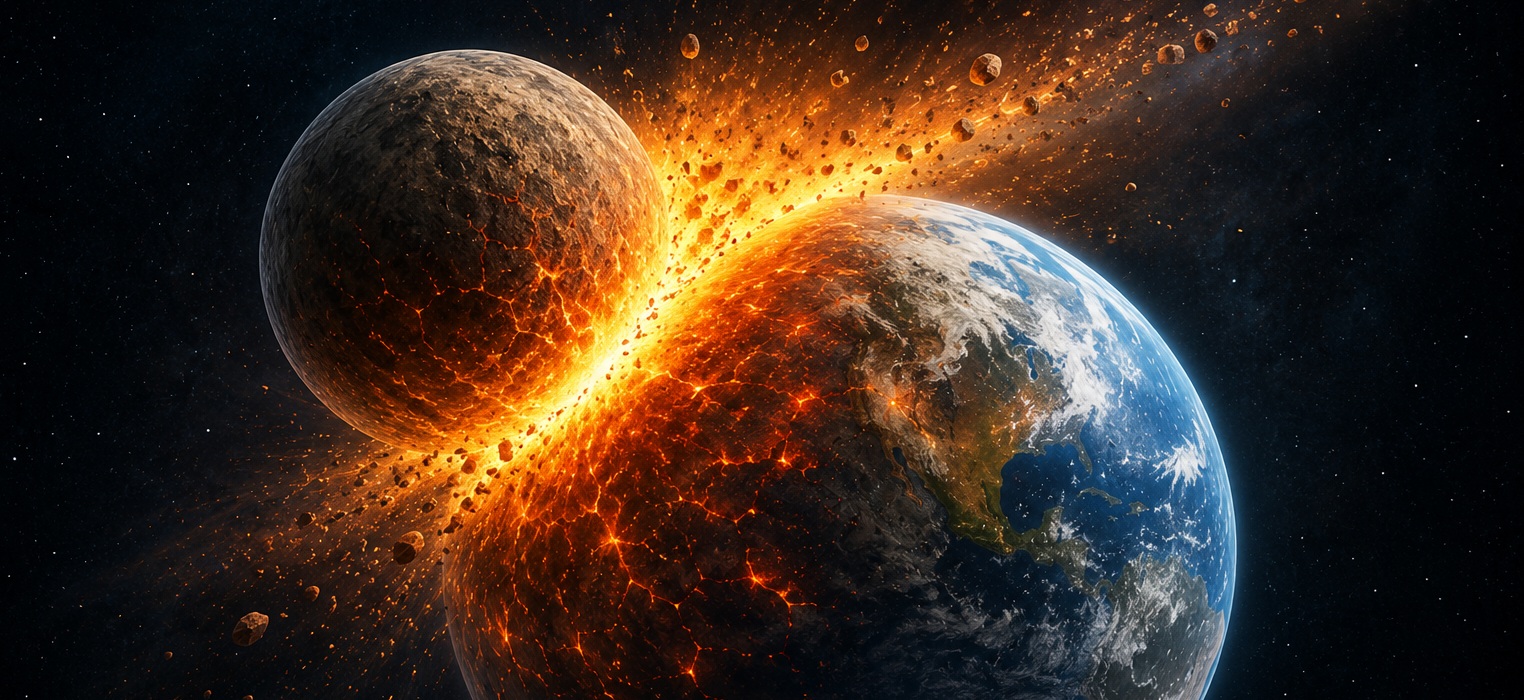
"I love three things in this world. Sun, moon and you. Sun for morning, moon for night, and you forever." This is a phrase everyone loves. Indeed, living on Earth, we are surrounded by these celestial bodies every day, and the two closest to us are the sun and the moon. Strangely, the sun is 8 minutes away from us if you travel at the speed of light, while the moon is 1 second away—a world of difference—yet they appear almost the same size in the sky. The sun is a fixed star, and the formation of stars follows a different theory, which we will omit here. Today, let's talk about the moon. Within our solar system, although there are only 8 planets, there are many moons. As a solid planet, Earth has one moon and Mars has two (Mercury and Venus have none). For gas planets, Jupiter has 95 moons, Saturn has 274, Uranus 29, and Neptune 16. The formation mechanism of these numerous moons of the gas planets is co-accretion. In other words, the moon was formed from the same gas and "dust disk" surrounding its parent planet during the early stages of planetary formation; this mechanism is the same as the formation of the early planets in the solar system. In contrast, the formation of the moons of solid planets may be quite different. For example, astronomers generally believe that our moon was formed approximately 4.5 billion years ago when Earth collided with a Mars-sized object called Theia. The ejected debris eventually coalesced in an orbit around Earth to form the moon. This collision theory aligns with the following known characteristics of the moon: 1) The stable isotope ratios of lunar and Earth rocks are almost identical. 2) Due to the conservation of angular momentum, the moon always faces the same side of Earth; the moon is like a piece cut from Earth, therefore the side facing Earth always faces Earth. 3) The inclination of the moon's orbit is similar to the Earth's rotation angle relative to the ecliptic plane. 4) Lunar samples retrieved by the Apollo spacecraft indicate that the moon once molten to a considerable depth. Specimens with such molten traces would require immense energy, like that from a collision. As the Mid-Autumn Festival (中秋節) approaches, gazing at the bright and serene moon, it's hard to imagine the dramatic upheavals that occurred billions of years ago when it was born.