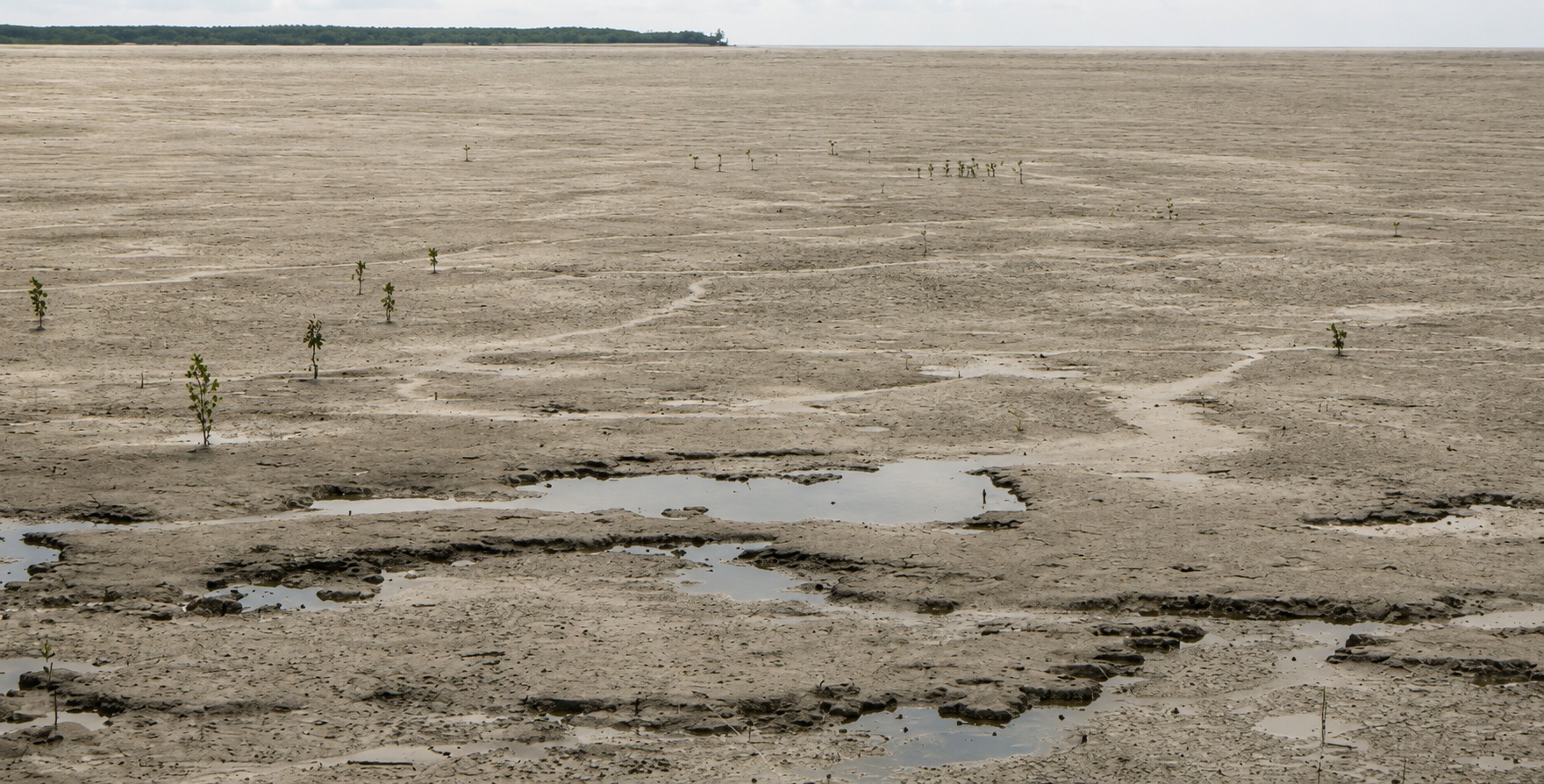
"The sea may dry up, the rocks may crumble" is a well-known Chinese idiom. Can the sea really dry up? The answer is yes, the sea really can! The Taiwan Strait, currently at an average depth of 60 meters, experienced a significant drop during the Last Glacial Period (LGP, 120,000 to 15,000 years ago). Due to prolonged low temperatures, polar ice caps continued to expand towards lower latitudes, causing ocean levels to drop. Later, around 25,000 to 15,000 years ago, the ocean level dropped by more than 100 meters. Therefore, the Taiwan Strait, connecting to the continental shelf of Vietnam and Indonesia, became dry land for approximately 10,000 years, connecting Taiwan with these regions. This allowed humans to migrate from the Baiyue region (百越地區) of Southeast Asia on foot, without needing to cross the sea, to settle in Taiwan, becoming the early indigenous people of Taiwan. (Later indigenous people, around 6,000 years ago, crossed the sea to Taiwan due to rising sea levels, bringing with them advanced navigation technology.) As for the reason why ice ages occur every tens of thousands of years in Earth's history, geophysical climate experts have stated that it is mainly due to the varying intensity of sunlight received by the Earth in high-latitude regions. During periods of weak sunlight, more ice forms and spreads towards lower latitudes; during periods of strong sunlight, the ice melts, and large ice blocks retreat to higher latitudes. This variation in sunlight intensity is influenced by 1) the precession period of the Earth's axis of rotation, 2) the periodic change in the angle between the axis of rotation and the perpendicular line to the plane of the Earth's elliptical orbit, and 3) the periodic change in the major axis of the Earth's elliptical orbit. These three periods are called the Milankovitch cycles, with periods of 26,000 years, 41,000 years, and 100,000 years respectively. The alternation of solar radiation intensity causes fluctuations in Earth's temperature. Ice ages occur relatively periodically on Earth due to the combined effects of these three cycles. During the "last ice age," Earth's temperature was about 18 degrees Fahrenheit lower than it is now. This "last ice age" ended more than 10,000 years ago. From the beginning of written history, 4,000-5,000 years ago, until now, we have been in a long interglacial period of transition from low temperatures to warmer conditions; during this process, the Earth's temperature has increased by an average of about 0.03 degrees Fahrenheit per century. This slow change in global temperature caused by the slow changes in the Earth's axis and elliptical orbit cannot explain the 1.1 degrees Fahrenheit increase we've seen in the past century. Have our 8 billion people unknowingly disrupted the Earth's own rhythm built up over billions of years?