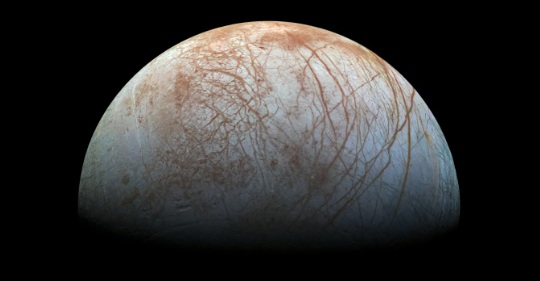
The United States spent a staggering $5.2 billion, all to ask a simple question unrelated to everyday necessities: "Can life exist elsewhere in the solar system?" To find the answer, on October 14th of this year (2024), NASA led the launch of the Europa Clipper spacecraft from Florida aboard a SpaceX Falcon Heavy rocket. The spacecraft is scheduled to travel 1.8 billion miles over five and a half years, heading towards Jupiter, which has 95 moons. Its target is Europa, a moon with a smooth, crater-free surface, potentially harboring life. The spacecraft will use various instruments to probe beneath its 10-mile-thick ice layer to determine if there is an ocean beneath the ice, and whether it possesses the energy and chemical conditions necessary to support life. The spacecraft's 1.8 billion-mile journey is somewhat circuitous; it doesn't fly directly to Jupiter, but instead first travels towards Mars. Then, using the gravitational pull of Mars, it will be flung back to Earth, and then, relying on Earth's gravitational pull, towards Jupiter. It is expected to arrive at Jupiter on April 11, 2030, and enter its orbit. The spacecraft will orbit Jupiter approximately once every 2-3 weeks. During its four-year orbit around Jupiter, it is planned to make 49 close approaches to Europa, with approximately one day allotted for testing each time. Jupiter is the largest planet in the solar system, its volume large enough to hold 1321 Earths, and its magnetic field is 20,000 times stronger than Earth's, comparable to the magnetic field strength of a hospital MRI machine. Under such intensity, radiation is very high, posing a significant danger to the spacecraft's instruments. Europa is one of Jupiter's moons, and it is inevitably subject to Jupiter's influence. Given Jupiter's immense size, its gravity is extraordinary, much like the tides on Earth caused by the gravitational pull of the moon and the sun. The seawater beneath the Europa ice is also influenced by Jupiter, experiencing constant tides. These tidal movements generate friction and heat, which is energy. We know that there are vents beneath Earth's oceans, where life exists. Europa might have them too. Furthermore, scientists have many other inferences based on past observations, all of which need to be verified. In short, to satisfy the whimsical curiosity untouched by reality—"Can there be life beyond Earth?"—the United States has spent a staggering $5.2 billion trying to answer this question for humanity. Isn't that a bit crazy?