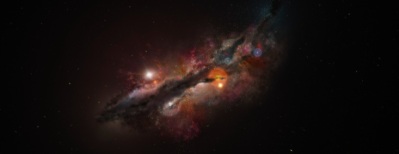
The James Webb Space Telescope is becoming increasingly adept at cosmic archaeology, finding galaxies from the early universe that are emerging earlier and earlier. The Big Bang occurred 13.8 billion years ago. Just two years ago (2022), the telescope discovered a galaxy that existed 325 million years after the Big Bang, named JADES-GS-z13-0 (z13 indicating a redshift of 13). This year (2024), it discovered another incredibly young galaxy, JADES-GS-z14-0 (redshift 14.3), which existed only 290 million years after the Big Bang. Generally, early universe galaxies are small and quite dim. However, z14 is a galaxy exceptionally large (1,700 light-years wide), radiant (containing 500 million stars), and containing a considerable amount of oxygen. It is billions of light-years from Earth, with a right ascension roughly equivalent to the constellation Aries, but its latitude is in the southern celestial sphere. Oxygen typically only appears after a vast period of time, after a multitude of stars have died out in supernova explosions. Just as an iPhone only appeared after a long period of continuous technological advancement by human civilization, it's impossible to find an iPhone inside a young, newly built Egyptian pyramid in the early stages of human civilization. Therefore, Kevin Hainline, an astronomy professor at the University of Arizona, said: "Seeing oxygen in such a young galaxy is like if you were an anthropologist and you discovered a giant ancient city with evidence of an iPhone inside it." The early universe and its galaxies are mysterious.
(2024-06-23)