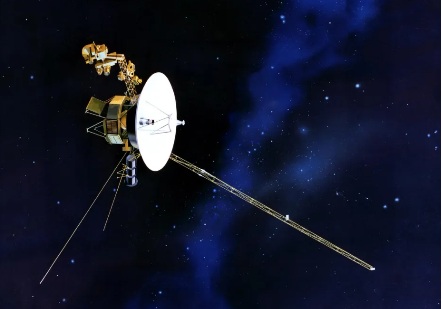
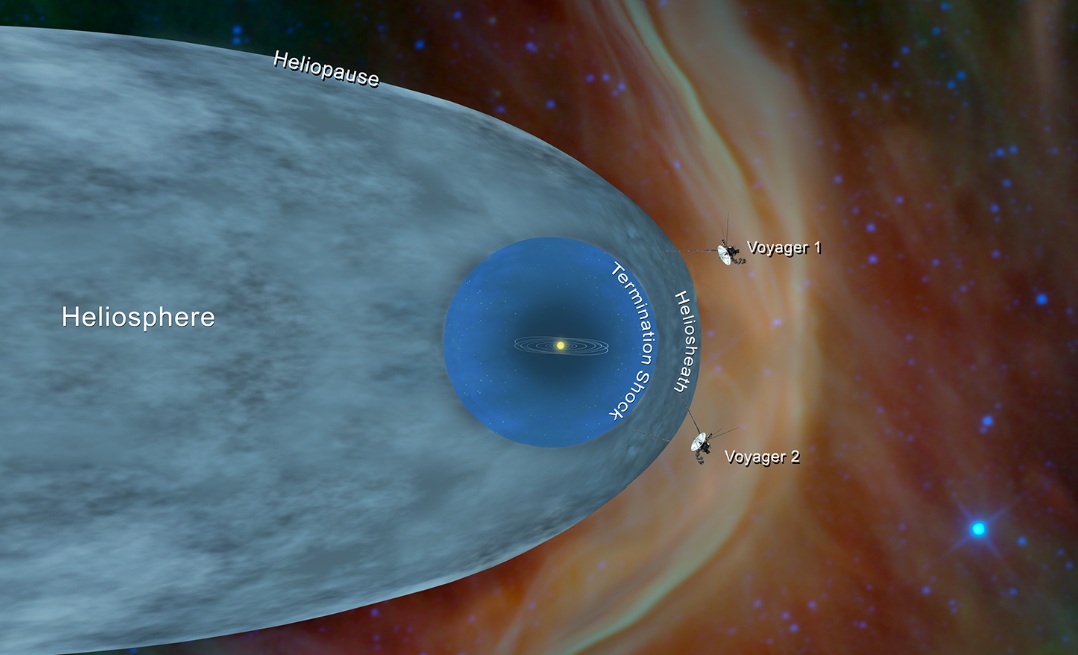
The Universe is vast and boundless, and humans, who are endlessly curious, must definitely find out. The United States NASA leads the way by launching five spacecrafts on behalf of mankind, waving to other civilizations in the universe (whose existence is unknown), and using pictures and words to describe who we are, where we are, and what era we live in. The first one was the "Pioneer 10" launched in 1972. It was quite lucky to safely pass through the asteroid belt between Mars and Jupiter, which is as dangerous as mines. It arrived near Jupiter, the largest planet in the solar system, 1 year and 8 months after launch. Then, it relied on the gravity of this large planet to throw the spacecraft out and rushed in the direction of "Taurus". It reached the orbit of Neptune 11 years and 3 months after launch. 31 years after launch, the signal was too weak and it lost contact with the earth. Although contact was lost, it is estimated that it will arrive at a certain star in the constellation of "Taurus" in about 2 million years. The second spacecraft was "Pioneer 11" launched in 1973. It also arrived near Jupiter about 1 year and 8 months after its launch. It also relied on its gravity to swing the spacecraft toward Saturn, and borrowed Saturn's gravity to swing it in the direction of "Sagittarius". It arrived in the orbit of Neptune 16 years and 10 months after its launch, and lost contact with the Earth about 22 years later. Although contact has been lost, it is estimated that it will arrive at a star in the constellation "Sagittarius" in about 4 million years. The other three ships currently in contact with the earth are "Voyger 1" and "Voyger 2" launched in 1977, and "New Horizon" launched in 2006. "Voyager 1" is assisted by the two stars Jupiter and Saturn. Heading to "Ursa Minor"; "Voyager 2" relies on the help of four stars, Jupiter, Saturn, Uranus, and Neptune, to run to "Andromeda"; "New Horizons" only relies on the help of Jupiter to run to "Sagittarius". Although "Voyager 1" only relies on the help of two stars, Saturn's help is particularly powerful, because NASA makes its flight orbit very close to Saturn, so among these five spacecraft, "Voyager 1" has the fastest speed, 18.6 kilometers per second. It is also the farthest one from the earth today, 170 astronomical units (A.U.). When it was about 40 AU from the earth (2/14/1990), it also turned its camera around and aimed at the earth to take a "Pale Blue Dot" photo, which amazed all mankind. And realize that the earth that is regarded as "home" by a population of 8 billion is so small, but so beautiful. As shown in the picture, "Voyager 1" and "Voyager 2" have penetrated the Heliopause ("solar wind boundary"; that is, the scope of the solar system, about 120 AU from the sun) in 2012 and 2018 respectively, breaking away from the control of the solar system and entering "interstellar space". It is equivalent to "wandering in the Great Void of Universe". In addition, the "Pioneer 10" that lost contact should also be "wandering in the Great Void of Universe" at this time.
1977 was a special year, as it coincided with an astronomical spectacle that occurs only once every 176 years. NASA chose this year to launch Voyager 2, completing its legendary "Grand Tour" to obtain assistance from four planets. Why can four planets provide continuous assistance to a spacecraft only once every 176 years? The reason is this: these four planets are all in circular orbits, although their radii differ, they orbit the Sun in the same direction. Jupiter completes one orbit in 11.86 years, Saturn in 29.46 years, Uranus in 84 years, and Neptune in 164.8 years. If Jupiter and Saturn start orbiting simultaneously, it would take Jupiter 19.85 years to catch up with Saturn in one orbit. This means that for any relative position of Saturn and Jupiter to repeat itself again, it would take 19.85 years (or a multiple thereof: n x 19.85 years). For Saturn and Uranus, it would take 45.37 years (or a multiple thereof). For Uranus and Neptune, it would take 171.36 years (or a multiple thereof). Now, extending this to any relative position of Jupiter, Saturn, Uranus, and Neptune, strictly speaking, it would take the least common multiple of these three numbers (19.85, 45.37, 171.36), approximately 150,000 years. Less strictly, then 9 x 19.85 = 178, 4 x 45.37 = 181, 1 x 171.36 = 171. These three numbers, 178, 181, and 171, are quite close. This means that in about 170 years, the relative positions of Jupiter, Saturn, Uranus, and Neptune will be very similar. NASA's precise calculations indicate a cycle of 176 years. The last time these four planets were in such a favorable position to provide continuous assistance to a spacecraft was in 1801. In 1977, these four planets formed this favorable position again, so NASA seized the opportunity to launch Voyager 2. The next time will be in 2153. (July 6, 2026)