The English word guessing game called Wordle has recently become a global phenomenon, reportedly with millions playing it daily. It takes just 3-5 minutes to guess a five-letter English word. Wordle releases a new word puzzle every day, allowing six attempts. Many people find it quite entertaining. (For those interested in English word guessing, you can find the Wordle Game daily in the New York Times.)
This game collects approximately 13,000 English words, all composed of five letters, as Allowed Words. There are about 2,300 "Answers". Each day's "Answer" is a five-letter word, and after approximately 2,300 days (over 6 years), the "Answer" repeats. To play, Wordle doesn't give you any hints; you must come up with a five-letter word from scratch as your first guess. If your guess isn't among the 13,000 Allowed Words, Wordle will tell you it's not acceptable, and you must guess another Allowed Word. Then, Wordle compares the five letters of your guess with the five letters of the "Answer". If your guess is among the five letters of the "Answer" and in the correct position, the square for that letter will be green. If it's in the wrong position, the square will be yellow. If your guess isn't among the five letters of the "Answer", the square will be gray. These colored letters provide extremely valuable information for your second guess. And so on... See if you can guess it within six tries.
Inspired by the game Wordle, I wondered what the structure of a similar Chinese game would be? It wouldn't be about guessing individual Chinese words, but rather idioms. There are many four-character idioms in Chinese, perhaps 20,000 to 30,000. Each idiom has four Chinese characters, just as each English word in Wordle has five letters. The problem is, even with ~14,000 English words of 5-letter, you can only use 26 letters to spell them and the comparison to the "Answer" is on the alphabet basis. But the total number of Chinese characters in all four-character idioms is likely tens of thousands. If you try to guess an idiom from scratch and compare it to the corresponding Chinese character (i.e., the comparison to the "Idiom Answer" is on the Chinese-character basis), the chance of guessing even one character correctly is extremely slim. A common way to condense tens of thousands of characters is through radicals. However, over 500 radicals are far too many. Another idea is to use four-corner codes to represent characters. This is also possible, but since each idiom has four Chinese characters, each character requires four spaces for you to guess its four-corner code. Guessing an idiom once would require filling in 16 spaces with numbers from 0 to 9. Compared to Wordle, which only requires filling in five spaces with English letters, this corner-code method has too many spaces to fill. Furthermore, the four-corner code is rarely used nowadays. Another method is to represent each Chinese character using the first letter of its Pinyin (also called the "head code"頭碼); that is, each Chinese character is represented by one English letter. This brings us back to the 26 letters of the English alphabets. The answer to the riddle, which is a four-character Chinese idiom, is represented by the first letter of each character, and is represented by a four-letter combination. Therefore, using the "head code" method literally transforms the answer to the four-character idiom into four English alphabets, one fewer than Wordle's five alphabets. For inputting the idiom, you can use Chinese input or head code input (the App accepts both uppercase and lowercase English letters for the head code). Regardless of whether you use Chinese or head code input, the App will convert your input into four English alphabets and then compare these four alphabets with the four alphabets of the answer one by one. This is the same logic as comparing Wordle's five alphabets with the five alphabets of the "Answer" one by one. Therefore, the treatment of the green, yellow, and gray squares follows the Wordle's approach. The only difference is that in the "Daily Idioms" App, the green and yellow squares, in addition to displaying the English alphabets, more importantly, also showing the Chinese characters for the answer. These Chinese characters, whether correct or incorrect, are valuable information that helps you guess the answer.
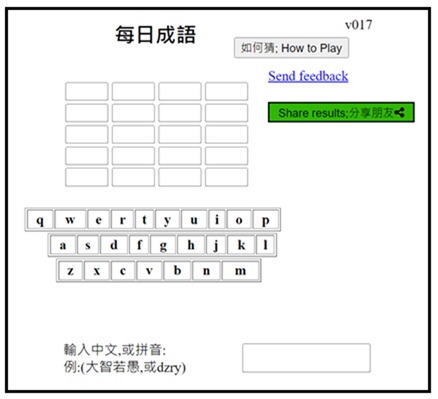
Based on this concept, I designed a "Daily Idioms" website: https://idioms.andrewl.in. It's a single webpage, as shown in Figure 1. First, click "how to play" to read the simple instructions and understand how to play the idiom game (those familiar with the Wordle will find it easier). Then, simply click on the large input field at the bottom; the cursor will move in that field, allowing you to enter the idiom you want to guess (using Chinese input or keypad input). Then, press the "Return" button at the bottom right corner of your iphone's keyboard; don't touch the other fields. After guessing the idiom correctly, click "Share result" to copy your guess to the clipboard, and then copy it to email or a LINE group to share your achievement with friends. Figure 2 shows the result copied to the clipboard.
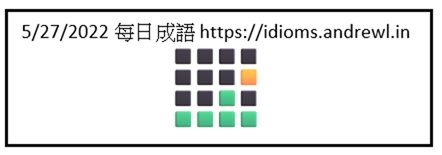
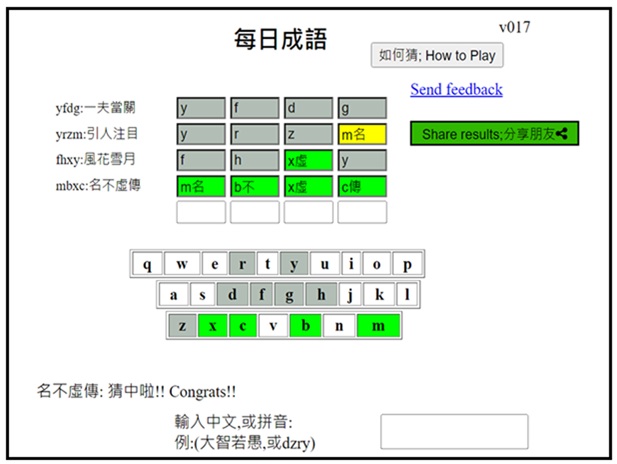
Figure 3 is an example showing my process of guessing idioms on this webpage one day. My first guess was "一夫當關" (I entered the prefix "yfdg"; you can also enter the Chinese characters "一夫當關"). Unfortunately, all four "head codes" did not hit any alphabets of the Answer. So, none were correct, and all four squares were gray. The "yfdg" letters on the English keyboard were also gray. My second guess was "引人注目" (I entered the prefix "yrzm"; you can also enter the Chinese characters "引人注目"). Although "目" (eye) wasn't in the answer, we didn't compare it to the individual Chinese characters, but rather to the alphabets. "m" is the "head code" for "目", and "m" is one of the four alphabets in the Answer, and its corresponding Chinese character in the answer was "名" (name). Therefore, we knew there was a Chinese character "名" in the answer, but its position was incorrect, so the square was yellow. Similarly, the "yrz" letters on the English keyboard were gray, and "m" was yellow. My third guess was "風花雪月" (I entered the prefix "fhxy"). You can also enter the Chinese phrase "風花雪月" (Feng Hua Xue Yue). Although "雪" (Xue) is not in the answer, its head-code 'x' is, and its corresponding Chinese character in the answer is "虚" (Xu), and the position is correct, so the grid is green. Similarly, the English keyboard keys 'fhy' are all gray, and 'x' is green. I thought, the answer contains "名" (Ming) and "虛" (Xu), and "虛" is in the third position, so I tried "名不虛傳" (Ming Bu Xu Chuan) (I entered the head-codes 'mbxc'; you can also enter the Chinese phrase "名不虛傳"). Sure enough, I guessed correctly, all four grids were green, and the English keyboard keys 'mbxc' were also green. After guessing, I clicked "Share results," and an alert window popped up. It said that the results of "Daily Idioms" had been copied to the clipboard, etc. You just need to click "close," and your guess will be copied to the clipboard. The clipboard only shows colors, without letters or Chinese character grids (as shown in Figure 2); you can copy... And paste it to your email or LINE group (if you're using your iphone to guess the "Daily Idiom"). Also, if you have feedback, click "Send feedback," and an email window will pop up asking for your comments. Click the send button, and the author will receive your feedback, review it, and reply. People all over the world can play. Only one new answer is given each day, updated at midnight. There are over 30,000 idioms; one a day, and you could play them all in a lifetime. This short article introduces the "Daily Idiom" website and shares it with readers interested in guessing idiom games. We hope you enjoy it every day!( Don Lin, 2025-07-07, New Jersey)