Since ancient times, people all over the world have been fascinated by the relationship between the phases of the sun and moon and climate change. Calendars have emerged to relate climate and agriculture in various places. For example, there is the lunar calendar we are familiar with, the Julian Calendar, the Jewish Hebrew Calendar, and Muslims also have their own monthly calendars. The Gregorian Calendar (which we call the solar calendar), being now more popular around the world, was officially promulgated by Pope Gregory XIII in 1583.
The Gregorian calendar is based on the Earth's orbit around the sun, ignoring the moon's cycle. In contrast, Muslims use a lunar calendar, which only considers the moon's cycle and ignores the sun's movement; a Muslim lunar month has 29 or 30 days, and a year has 12 months. Compared to both the Gregorian and lunar calendars, the Chinese lunar calendar is a combined lunisolar calendar, taking into account both the sun's and the moon's cycles.
When discussing the cycles of the sun and the moon, astronomy inevitably comes into play. Astronomy encompasses the universe—it's vast—but only two of the largest celestial bodies in the sky are truly relevant to everyday life: the sun and the moon. Astronomers' observations of the sun and moon can be traced back 5,000-6,000 years. At that time, humans lived on Earth and considered it stationary; naturally, they assumed it was the center of the universe, since all celestial bodies appeared to revolve around it. Even ancient thinkers—Aristotle of Greece and Ptolemy of Egypt—believed the Earth was the center of the universe (the so-called "geocentric model"), and various religions naturally followed suit, almost without question. This "geocentric model" was overturned in 1543 by the heliocentric model, proposed by a Polish Catholic and astronomer, Copernicus, who proposed that the Earth revolves around the sun and that the sun is the center of the universe. It shook the geocentric worldview dominated by Ptolemy for 1500 years, thus clashing with the Catholic Church. Later, in 1609, German astronomer Kepler, based on observations, summarized the laws governing planetary orbits around the sun, increasing the credibility of the heliocentric model. Later, in 1610, Italian astronomer Galileo Galileo, using his homemade telescope, observed that Jupiter's four moons were orbiting Jupiter, proving that not all celestial bodies orbit the Earth, strongly refuting the claim that the Earth was the center of the universe. He also wrote books publishing his observations, supporting and advocating Copernicus's heliocentric model. For this, at the age of 62, he was tried by the Roman Catholic Church, his books were banned, and he was sentenced to house arrest until his death at the age of 72 (1642). (Note: The Vatican lifted the ban in 1882, and in 1992, the Vatican declared Galileo innocent, clearing his name.)
Based on past theories and observations, the great British physicist Isaac Newton published his law of gravitation in 1687, almost perfectly explaining the motion of all celestial bodies. This included the precise prediction of the orbital positions and periods of the moon around the earth and the earth around the sun. Of course, previous generations had also known these periods through observation, but now, the principle of gravitation in physics allows for the precise calculation of these orbital positions and periods. This data is what is needed to establish the lunar calendar.
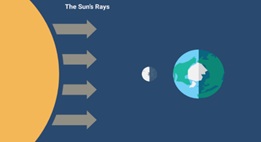
Steps to create a lunisolar calendar:
Step 1: The moon has new moons and full moons; the lunisolar calendar uses the new moon (朔) to mark the first day of each month. The time from the first day of the new moon to the first day of the next month can sometimes be 29 days, sometimes 30 days. A new moon occurs when the sun, moon, and earth align in a straight line (as shown in Figure 1, the moon is not visible at night). Astrophysics can precisely calculate the exact year, month, day, hour, minute, and second when the three spheres align.
Step 2: The winter solstice always falls in the eleventh month of the lunisolar calendar.
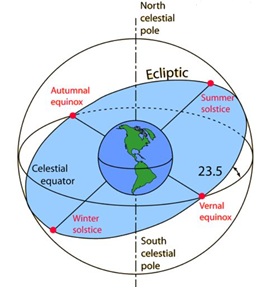
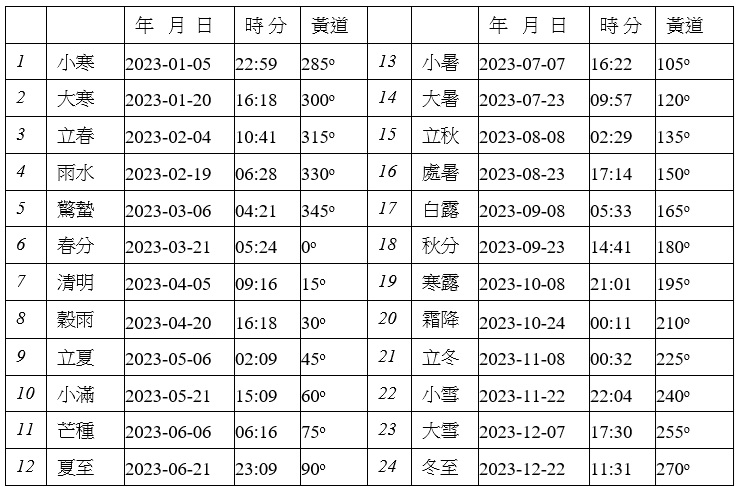
Step 3: The ecliptic (as shown in Figure 2) has a circle of 360 degrees, and every 15 degrees is designated as one Qi (氣). (360 ÷ 15=24. 12 of them are "Jie-Qi"(節氣), and the other 12 are "Zhong-Qi"(中氣). Together they are called "Solar Terms", As shown in Figure 3: When the sun reaches 15o of the "ecliptic" at certain month-day-hour-minute-second, the "Qingming" (清明) Solar Term begins at that precise time; when the sun reaches 90 degrees of the "ecliptic" at certain month-day-hour-minute-second, the "Summer Solstice" (夏至) Solar Term begins at that precise time. Note: The "fixed qi" method is used here). For the 24 "Solar Terms" every year, astrophysicists can accurately calculate the time, minutes, and seconds for each solar term to occur on that month and day of that year.
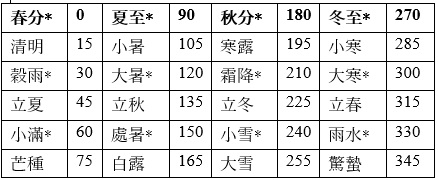
Step 4: Intercalation method: A lunisolar month that does not contain a single "Zhong-Qi solar term" is designated as an intercalary month. For all other cases, it is a regular lunar month.
Example: Drafting the 2023 Lunisolar Calendar (Due to space limitations, only January to April will be illustrated):
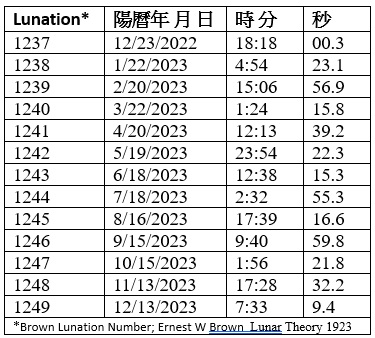
First, we need the precise time of the new moon (Figure 4) and the times of the 24 Solar Terms (Figure 5) (all using Taiwan time). These can be precisely calculated using astrophysics. Those interested can refer to "Astronomical Algorithms," 2nd Ed., by J. Meeus, or NASA's Horizons website: Horizons System (nasa.gov). The information is very comprehensive.
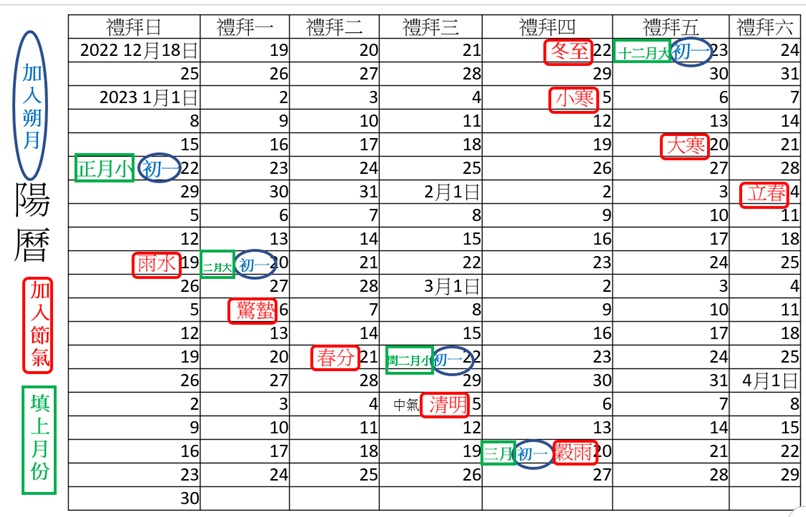
Next, use the following Gregorian calendar table for January to April 2023 and follow four steps to create the calendar (Figure 6).:
- Using the data from Figure 4, add the new moon (first day of the lunisolar month) to Figure 6 (in blue).
- Using the data from Figure 5, add the Solar Terms (in red) to Figure 6. Next, fill in the months (in green). This is more complex, and the explanation is as follows::
- Examine the red box between the two first days of the lunisolar calendar. Does it contain a month with at least one "Zhong-Qi"(中氣)? If so, it is a regular lunar month; otherwise, it is a leap month.
- Find the day marked with a red box for the Winter Solstice. The Winter Solstice always falls in the 11th month of the lunisolar calendar. The next first day of the next month is the 12th month. If this month has 29 days, it's called a short month (12th month); if it has 30 days, it's called a long month (12th month). Currently, this month has one "Jie-Qi"(節氣) and one "Zhong-Qi"(中氣), so it's not a leap month. Next is the first month of year, which is short because it has 29 days and also has one "Jie-Qi" and one "Zhong-Qi". Next is the second monthof year, which is long because it has 30 days and also has one "Jie-Qi" and one "Zhong-Qi". Next is the leap second month of year, which is short because it has 29 days but only one "Jie-Qi" which is Qingming (清明), lacking a "Zhong-Qi" (中氣), so it's a leap month. Because its preceding lunar month is the second month, this leap month is called the "Leap Second Month."
Nineteen years and seven leap years: As early as the Spring and Autumn Period (春秋時代) and the Warring States Period (戰國時代), the Chinese calendar adopted the arrangement of seven leap months in nineteen years; astronomers in Athens, ancient Greece, also observed that the cycle of 19 tropical years is almost exactly equal to 235 synodic months. The reason is that a year is approximately T1=365.24218 days, and the average lunar month is approximately T2=29.53059 days. How many lunar months are there in a year? The answer is: T1/T2=12.36827 months, 12.36827 is not an integer. There are 24.73653 lunar months in two years, which is not an integer. Extending to 19 years, there will be 234.99713 lunar months. Although it is not an integer, it is almost 235 lunar months. If it is required to have 12 lunar months in a year, there are only 228 lunar months in 19 years. To reach 235 lunar months, the missing 7 lunar months must be made up with 7 leap months. That is, we add 7 leap months in 19 years so that the lunisolar calendar will not be out of sync with the solar cycle, and to ensure that the Winter Solstice and the Spring Festival (春節) will fall in the cold winter. As for how to insert 7 leap months in 19 years (the leap method), ancient almanacs and dynasties have different methods. The fixed-qi leap-setting method described above in this article is a modern method.
Chinese Zodiac: Heavenly stems (天干) and earthly branches(地支) have been used to record years since ancient times (e.g., the "Xinhai"(辛亥) revolution occurred in the year of Xinhai(辛亥), and the "Gengzi"(庚子) indemnity occurred in the year of Gengzi(庚子)). There are 10 heavenly stems (甲乙丙丁 etc.) and 12 earthly branches (Zi=子, Chou=丑, Yin=寅, Mao=卯 etc.). The least common multiple of 10 and 12 is 60. Therefore, the heavenly stems and earthly branches repeat every 60 years. The corresponding animal representatives of the 12 earthly branches are the 12 zodiac signs. Therefore, Zi, Chou, Yin and Mao are respectively rat, ox, tiger, rabbit, etc. For example, if you are born in the year of Ding-Hai (丁亥), the earthly branch is "Hai" and the zodiac sign is "pig". However, the year of the Heavenly Stems and Earthly Branches does not start with the first day of the lunar calendar, but with "The Beginning of Spring" (立春), around February 4th in the Gregorian calendar). For example, on January 30, 2023, if we look at the perpetual calendar, we can find that this day is still in the "Yin Yin Year"(壬寅年): Yin of the Earthly Branch = Tiger. In a few days, February 4, 2023 will be the "Beginning of Spring"(立春), and the year of the Heavenly Stems and Earthly Branches will become the "Year of Gui-Mao"(癸卯); the Earthly Branches' Mao = Rabbit. Despite the evolution of history, modern people have become accustomed to using the solar calendar, and the lunisolar calendar has almost become a kind of "archaeology". Most people only remember the Chinese New Year. Therefore, the zodiac is mistakenly based on the "Spring Festival"(春節) which is the first day of the first lunar month, instead of the correct "Beginning of Spring"(立春) which is around February 4 of solar month (i.e. Gregorian Calendar).