Ancient Egypt, the first civilization in human history to use hieroglyphics, was located in North Africa, in the Nile Delta region, more than 5,000 years ago. It spanned 33 dynasties. They developed writing, mathematics, and astronomy. The pharaohs (rulers of ancient Egypt) began building the pyramids approximately 4,700 years ago. It is truly a miracle that humanity could progress to the point of building such massive pyramids in the ancient era, with an incredibly precise orientation of true north (an error of only 0.05 degrees).
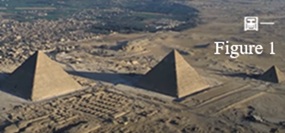
As for why the pyramids were built, this traces back to the ancient Egyptians’ view of life. The ancient Egyptians viewed life as a stage in an eternal journey, not simply being born into this world, living a full life, and then dying. While earthly life was important, for the ancient Egyptians, it was merely the preparation for a longer afterlife (Eastern cultures believe in the soul’s ability to reincarnate, possibly influenced by the ancient Egyptians). Life was part of the cosmic order; the ancient Egyptians called this cosmic order “Ma’at”, representing truth, balance, order, harmony, law, morality, and justice. Ma’at was personified as a goddess, with an ostrich feather in her hair. After death, Osiris, the god of the underworld, would weigh the person’s heart against the feather of Ma’at. If the heart was light (of high virtue), eternal life would be granted. If the heart was sinful, destruction would follow. Therefore, moral conduct in daily life was of paramount importance. Furthermore, they believed that a person is composed of multiple parts: “Khat” is the body, “Ka” is life force, “Ba” is personality and soul, and “Akh” is the transformed soul. Preserving the body (mummification) is crucial so that “Ka” and “Ba” can reunite. Death is merely a transition, a “turning point,” not an end. Ancient Egyptians had scriptures such as the Book of the Dead, inscribed on tomb walls, guiding the deceased on their journey to the afterlife. These views on the soul and the physical body predate the birth of Christianity by at least 2500 years. While their views on the soul and life were largely consistent, their views on the physical body differed greatly: the ancient Egyptians believed that although the soul departs at the time of death, it must remain connected with the mummified body to attain eternity. However, the 70-plus-day mummification process was likely too complicated, so Christian doctrine, more than 2500 years later, allows the body to decay, but God will bestow a glorious body at the end times, which will unite with the soul to attain eternal life. Nevertheless, the emphasis on and longing for the soul’s return to heaven remains the same.
The ancient Egyptians viewed the Pharaoh as a deity sent to earth, a ruler who maintained the earthly realm of Ma’at. Ancient Egyptian society was strictly hierarchical, yet each role maintained the balance of the universe. Family life, work, and responsibilities were all sacred and inviolable. In short, the ancient Egyptians believed that life was a stage on the path to immortality; death was not the dark end of life, nothing to fear, but immortality—this was the sacred cosmic order. Therefore, the ancient Egyptians believed that although the body died, the soul would continue to be reborn, and the eternal stars were the soul’s final resting place. They believed that the Pharaoh’s soul would ascend to heaven after death and unite with the eternal stars. The construction of the pyramids was the Pharaoh’s mausoleum, a launchpad, a springboard for the soul’s return. The largest of these mausoleums is the pyramid of Pharaoh Khufu of the Fourth Dynasty of ancient Egypt, located on the Giza Plateau about 10 kilometers southwest of Cairo. It is also known as the Great Pyramid of Giza (Figure 1 shows three pyramids; the largest one on the left is the pyramid of Pharaoh Khufu; the one in the middle is the pyramid of his son Khafre; and the smallest one on the far right is the pyramid of his grandson Menkaure).
Although the ancient Egyptians believed the stars were eternal, astronomical observations revealed that they revolved in concentric circles (one revolution per day; however, their light during daytime was obscured by sunrise). This meant that the closer a star was to a point in the northern sky, the smaller its circle became (Figure 2). For the ancient Egyptians, that point was absolutely eternal and immortal. This concept transcends geographical boundaries; it was also firmly believed in the later Chinese Zi Wei Dou Shu (Purple Star Astrology), because the “Zi Wei Star” is the “North Star.” During the Northern Song Dynasty (960-1127 AD), when Zi Wei Dou Shu was developed, Polaris (brightness 1.97) was precisely the star located at the North Pole. It remained stationary year-round. The North Star was the “Emperor Star,” and all other stars revolved around it. Therefore, the “Zi Wei Star” held a lofty and unparalleled status. The location of the “Zi Wei Star” in the 12 palaces of the natal chart is crucial to the chart’s fortune. Hence the saying, “When the Emperor Star moves, the constellations rush about.”
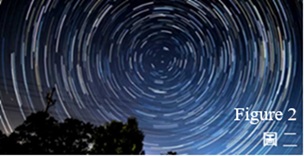
The ancient Egyptians built the pyramids between 2686 BC and 2181 BC, more than 3,000 years earlier than the Northern Song Dynasty. China at that time was roughly in the late Neolithic period. During the time of pyramid construction, the center of the concentric circles of stars was near the star Thuban in the constellation Draco. However, its brightness was only 3.65, making it difficult to see with the naked eye. For the pharaohs and ancient Egyptians, accurately aligning the pyramids with this “point of eternity” was crucial and could not be taken lightly. Therefore, finding and precisely aligning it tested the ancient Egyptians’ precise understanding and mastery of geometry and astronomy. The pyramids’ square bases reflect their mastery of stable structures and geometry. This also echoes their pyramidal design, symbolizing solidity and eternity. The pyramids’ orientation reflects the pharaohs’ beliefs and cosmology, closely linking the eternal future with the celestial bodies.
The construction of the pyramids carries various meanings. Their soaring height symbolizes the soul’s return to heaven. Therefore, the pyramids project upwards, unlike in the East where tombs are underground. Ancient Egyptians observed celestial phenomena and believed that stars near the North Pole never descended below the horizon, and that the underground possessed the characteristics of hell; thus, these stars were considered “imperishable.” Stars that never descended below the horizon were called circumpolar stars. For the people of Cairo, Egypt, circumpolar stars were all stars with a declination greater than 60°. The Great Pyramid had to be built with extremely precise northward orientation, meaning it had to be precisely aligned with the celestial North Pole. For modern people, the North Pole is the point where Polaris, the North Star, is located; it’s easily found at the end of the handle of the Little Dipper. However, 4,000-5,000 years ago, Polaris was quite far away from the North Pole. There were no bright stars near that point. Locating the North Pole was not so simple for the ancient Egyptians.
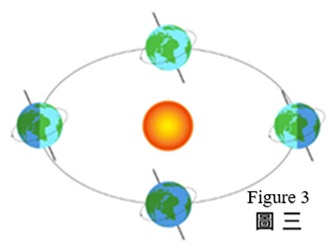
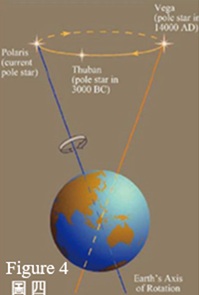
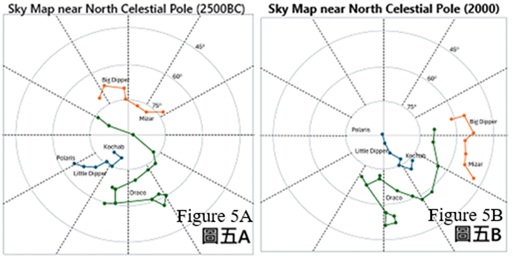
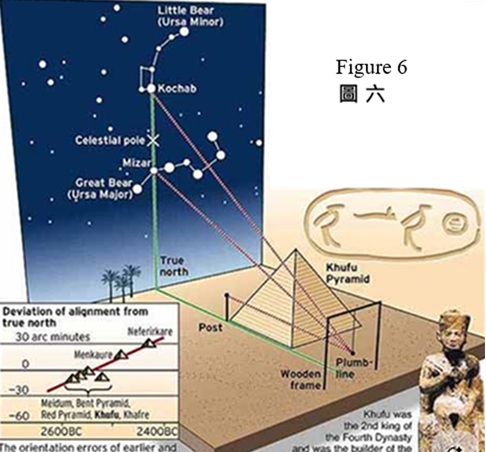
How the Ancient Egyptians Used Astronomy to Find True North: Thanks to advancements in astronomy, modern humans know that the Earth actually revolves around the Sun, while rotating on its own axis (Figure 3). The North Pole is the point where the Earth’s axis of rotation points towards the celestial sphere (Figure 4). We also know that the Earth, like a spinning top, wobbles as it spins. This phenomenon is called “precession.” A spinning top’s axis precesses 360 degrees, if it can, in about 3-4 seconds. The Earth’s spinning axis precesses 360 degrees in about 26,000 years, tracing a circle on the celestial sphere (see the top of Figure 4). The reason for the Earth’s precession is mainly because the Earth is not a perfect sphere; its bulge at the equator is obvious. The bulge of the Earth’s equator, when the gravitational forces exerted by the Moon and Sun are considered, results in a gravitational torque difference that produces precession (astrophysical calculations show the precession period to be 26,000 years). Since it completes a full rotation (360 degrees) every 26,000 years, the elapse of time between the construction of the Great Pyramid in 2500BC and now, about 4,500 years, would see a precession angle of approximately 62 degrees, which is substantial and would place the North Pole at the location of Polaris (Figure 4). Using modern astronomical knowledge, we can calculate the constellation map near the North Pole during the Pyramid Era (2500 BC), as shown in Figure 5A, to compare with the current constellation map (Year 2000) (Figure 5B). Both maps, besides the three constellations (Little Dipper, Big Dipper, and Draco), have three circles at latitudes of 45°, 60°, and 75°. The point at 90° is the North Pole. From Figure 5B, it is clear that in 2500 BC, Polaris was quite far from the North Pole. Therefore, the North Star for the ancient Egyptians was not the bright Polaris (magnitude 2.02), but rather the dimmer Thuban (magnitude 3.65) in Draco. Thus, the ancient Egyptians used two brighter stars near the North Pole to locate it. These two stars are Kochab of the Little Dipper. (Brightness 2.08), and Mizar (brightness 2.27): The North Pole is very close to the line connecting these two stars. The pyramid builders observed these two stars at night, and when they were vertically aligned in the sky (Figure 6), they suspended a plumb line. Then, standing behind the plumb line, they adjusted their line of sight (moving their eyes) to make the plumb line appear to overlap with the two stars; this was the direction of true north. It is said that the ancient Egyptians used this method to build the foundation of the western side of the pyramids to align true north, with an error of only 0.05 degrees.
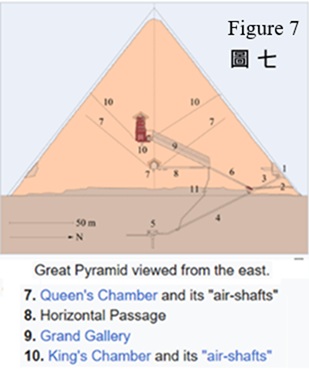
North-South Ventilation Shafts inside the Great Pyramid are aligned with the North Pole and the constellation Orion: Osiris, mentioned above, has an important story in ancient Egyptian mythology. He was the son of Geb, the god of the earth, and Nut, the goddess of the sky. He later became King of Egypt and married Isis. Osiris was later murdered by one of his brothers, and his body was dismembered and scattered throughout Egypt. Isis traveled throughout Egypt searching for her husband’s fragments. She stitched them back together and even briefly resurrected Osiris using magic. (This is the earliest myth in human history about resurrection after death.) Osiris did not return to rule the human world; after his death, he ruled the underworld. According to pyramid inscriptions, his soul ascended to the sky and became the constellation Orion. Therefore, Osiris symbolizes resurrection, immortality, morality, justice, and the cycle of life and death. Every deceased pharaoh longed to become Osiris. This myth is not just a story, but a universal truth: death is not the end, the body must be preserved (mummified), and life is part of a larger cycle. In ancient Egypt, every deceased person hoped to become Osiris in the afterlife. This belief is also reflected in the construction of the Great Pyramid. In Figure 7, the Great Pyramid contains two chambers: the King’s Chamber and the Queen’s Chamber. Each chamber has two air vents, one on the north side and one on the south side. The north air vent points towards the North Pole; the south air vent points towards the belt of Orion. This orientation represents the soul’s return to the North Pole and the constellation Orion, achieving “eternal life.”
Heliacal Rise of Sirius and the Flooding of the Nile: We now know that the Earth revolves around the Sun. However, the ancient Egyptians only knew that the Earth was stationary, and the Sun orbited the sky once a year along an orbit called the Ecliptic. Around the Ecliptic are the 12 zodiac signs, also known as the 12 constellations. The Sun visits each of these 12 signs every year. From Earth’s perspective, if a star is hidden behind the Sun, we cannot see it. This is because when the Sun rises in the east, the star also rises in the east, but the sunlight is too strong and the starlight too weak to be visible. However, the Sun moves slowly along the Ecliptic. A star that was originally hidden behind the Sun will no longer be hidden and will gradually rise a little earlier than the Sun. When the angular distance between the star and the Sun is large enough, we can see it before sunrise. This phenomenon is called “heliacal rising.” Ancient Egyptians, observing Sirius, the brightest star in the sky, discovered that when it Sirius was in heliacal rising (visible at dawn), it coincided with the Nile River beginning to flood. For the ancient Egyptians, the Nile’s flooding was a good thing, as it brought fertile black silt to the fields. This fertile soil enabled agriculture on the previously desertified land, feeding millions of people. This formed a powerful symbolic system: Sirius (associated with the goddess Isis) appearing in the east at dawn, the floods bringing black silt, fertilizing the land, and nurturing the rebirth of life; the river’s cycle reflected the myths of death and resurrection.