For most people, "quantum computer" is something pretty remote to consider. After all, the principles of "quantum mechanics" are incredibly profound and unpredictable, often described as "heavenly scripture," and backed by a mountain of advanced mathematics that can be daunting to even begin to comprehend. Without a foundation in physics and mathematics, it's truly difficult to understand. Now, the idea is to design a strange computer that incorporates this incomprehensible theory, leaving the general public utterly bewildered and helpless.
The reason is very simple. Things that are easy to understand are probably things that are close to daily experience; things that are divorced from daily experience are usually more difficult to understand. Most of daily experience is through our senses: we can see, hear, and touch. These sensory experiences form the basis for our understanding of nature. Physics is a science of understanding nature. Physics in ancient times relied mostly on the senses, with few supplementary instruments, and the principles of nature that could be understood were limited. "Law of Buoyancy", a bathtub; Like the "leverage principle", a stone, a stick. Later in 1609, "Galileo" learned to grind lenses, carefully improved his telescope. When he lifted his telescope and saw that the four moons of Jupiter did not revolve around the earth like other celestial bodies, but around Jupiter itself, he realized the "geocentric theory" of daily experience at that time would not hold. By the 1920s, the concept of "the eternal, static universe" of daily experience could not stand up to the data observed by Edwin Hubble using the best telescope of that time: the data clearly showed that "the universe is expanding". Also, in order to explain the "atomic spectrum" phenomenon seen by the "spectrometer", "quantum mechanics" came out in the 1920s. The view of "quantum mechanics" that "measurement results can only be predicted with probability" has subverted many of our daily cognitions and challenged the intuition of "causal determinism" that we have believed true for thousands of years. The universe is showing that its deepest operating methods do not necessarily conform to human daily sensory experience. Therefore, even the extremely smart "Einstein" was confused. In fact, in 1927, at the "Solvay Conference" where many Nobel Prize-winning physicists gathered, he plausibly asked the master of quantum physics, Niels Bohr, "Do you really believe that the moon only exists when I look at it?" "Einstein" has always believed that "God does not play dice" throughout his life, and he is dubious about "quantum mechanics".
However, the principles of quantum mechanics are rock solid; all experiments since the 1920s have proven consistent with quantum mechanics. Its perfect description of the behavior of electrons in solids laid the theoretical foundation for semiconductor physics, leading Bell Labs to invent the remarkable transistor in 1947. What was unexpected at the time was the computer revolution sparked by the invention of semiconductors, which greatly guided human civilization in the direction we see today. Building upon traditional computers, and leveraging the high-speed computing and massive storage capabilities of nanoscale semiconductors, humanity has developed the almost all-encompassing internet, the mobile phone in everyone's pocket, and the almost-omnipotent artificial intelligence (AI).
As we all know, the foundation of computer operations is the logic of 0s and 1s. Those familiar with the history of personal computers know that computer word sizes have evolved from 4, 8, 16, 32, to today's 64 bit systems. Each bit's stable state is either 1 or 0. Designing a computer this way has several advantages: strong anti-interference capabilities, simple binary logic circuits, and energy efficiency. Traditional binary digital computers, designed this way, have served various industries for decades. The shift from initial amazement at computers to current accustomed use indicates that people's horizons have broadened, and they are beginning to think about the next step: tackling areas where traditional computers fall short, yet are closely related to future life. These areas are mostly familiar to humans, but simply too numerous or too complex. For example, how the body responds to medication; how to prevent aging; weather forecasting; human language; facial recognition; chess and strategy problems, path planning and logistics, financial markets, molecular and materials design, new drug design, fast factorization of huge integers, huge combinatorial optimization problems (airline scheduling, logistics distribution, power grid dispatch), chip design, and new materials exploration (more efficient solar energy materials, new magnetic materials, room temperature superconductors). To solve these problems, people are turning their attention to quantum computers. In addition, for those problems that are themselves quantum systems, such as the electronic behavior of molecules and materials, traditional computers often have to use exponentially growing resources to simulate them. The reason why "quantum computers" are so highly anticipated is precisely because they adhere to "quantum mechanics," making them theoretically more suitable for simulating problems in the quantum world. Indeed, Richard Feynman, the 1965 Nobel laureate in Physics, stated in his 1982 paper "Simulating Physics with Computers": "Nature is quantum, not classical. So if you want to truly simulate nature, you have to use computers that follow the principles of quantum mechanics, not conventional computers. It's a very fascinating challenge, but it's really difficult."
Biggest difference between traditional computers and quantum computers: Let's illustrate this difference with a simple "four-bit" computer. Since each "bit" has two values (0 and 1), the combination of four bits has 24 = 16 states. These 16 states are |0000>, |0001>, |0010>, |0011>, ...|1111>. A characteristic of traditional computers is that at any given time, each four-bit combination is always in one of these 16 states. That is, 100% in this state, 0% in one of the other 15 states. The "four-bit" "quantum computer" is different. At any given time, each four-bit combination can be in a "quantum superposition state." For example, 80% in |0000>, 20% in |0001>. If you prepare 100 four-bit combinations in this state and then "measure" which state they are in, the result is that about 80 are in |0000> and about 20 are in the state |0001>. If Einstein saw this result, he would exclaim "Incredible!": 100 quantum systems prepared in exactly the same way produce different results when measured! Furthermore, a "quantum superposition state" can also be an "equally weighted" superposition of 16 states, each accounting for 6.25%. The power of a "quantum computer" lies in its ability to utilize the properties of "quantum superposition states" to represent all possible states in the same quantum state, gradually increasing the probability of the correct answer through step-by-step calculations. Therefore, a problem that would require thousands of steps for a traditional computer can be solved in ten or a hundred steps with a "quantum computer."
A Few Algorithms in Quantum Computing:
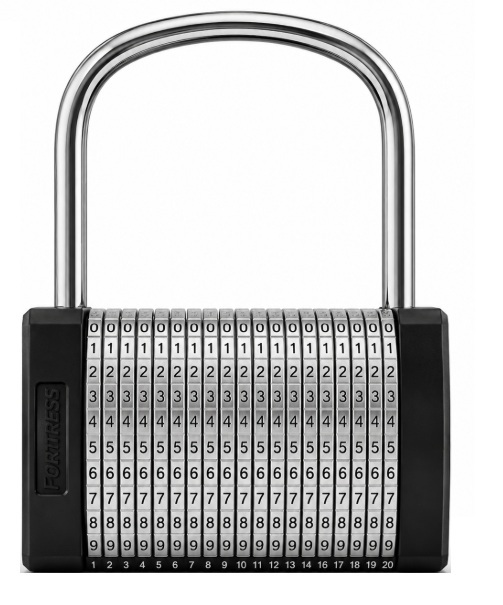
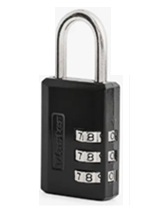
(A) Grover's Algorithm:After graduating from Stanford University, Grover joined Bell Labs in New Jersey. In 1996, through his research, he developed this "quantum mechanics" algorithm for database searching to find the correct answer. A simple example is a three-ring combination lock available at Home Depot/Lowe's. Each ring has ten numbers (as shown in Figure 1). Only one set of numbers can unlock the lock. With a traditional computer, the method is to try (0,0,0), and if that doesn't work, try (0,0,1), (0,0,2), and so on, until it is unlocked. It would take at most 10³ = 1000 tries to unlock it. For this simple problem, N = 1000. If one try takes 1 nanosecond, 1000 tries would only take 1 microsecond. Now, let's change to a 20-ring combination lock (as shown in Figure 2). A traditional computer guarantees unlocking it in 10²⁰ tries (for this more complex problem, N = 10²⁰), which is 10¹¹ seconds, approximately 3,000 years. Using a quantum computer to execute Grover's algorithm, it only requires approximately the square root of N, or 1010 times, to have a very high probability of solving it, which is 10 seconds (assuming a quantum query takes only 1 nanosecond). 10 seconds is a huge improvement over 3,000 years, demonstrating the incredible power of a quantum computer.
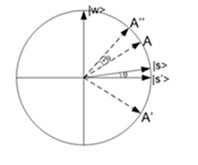
How can a "quantum computer" be so powerful? We'll use the three-ring combination lock example to explain the magic of how Grover's algorithm works in a "quantum computer." Here's how: Solving a three-ring combination lock involves 1000 possible solutions, but only one is correct. The first step of the algorithm is to create a "quantum superposition" of the 1000 possible solutions, ensuring that no single solution is superior to the others. This "quantum superposition" state is simply a vector (let's call it vector S, see Figure 3) in a 1000-degree space (sorry, a little basic math is necessary). There are two other related vectors: one is the correct solution's own vector (let's call it vector W), and the other is the "quantum superposition" state of all other solutions (the so-called "non-W") (let's call it vector S'. The angle between S and S' is θ). In Figure 3, we plot W as the y-axis, and S' as the x-axis; x-axis and y-axis are perpendicular to each other. The second step involves two consecutive "rotation techniques." First, vector A is rotated to A' along the vector axis S'. Then, A' is rotated to A'' along the vector axis S. After these two rotations, the resulting vector A'' is shifted by an angle of 2θ towards the correct answer W. If the A'' vector is rotated twice more, the resulting vector is even closer to the correct answer W (again, by an angle of 2θ). This process is repeated 32 times (N = 1000 and its square root is approximately 32), resulting in a vector that almost overlaps with the W vector. The proportion of "non-answer" values becomes negligible. Therefore, what a traditional computer needs to do 103 times, a quantum computer can solve in 32 times, i.e., 32 times faster. For a 20-ring combination lock, a traditional computer needs N = 1020 times, whereas a quantum computer only needs 1010 times (the square root of N) to solve it. It's 1010 faster, ten to the power of 10, which is 10 billion times faster. The capabilities of "quantum computers" are incredible! This is because the "quantum superposition" state puts all possible answers into one basket. So, when processing this basket, we are using "quantum superposition" to let all possibilities evolve together, and then using "quantum interference" to gradually increase the probability of the correct answer, instead of processing them one by one in sequence like traditional computers. "Simultaneous processing" is why "quantum computers" have such super power.
How many qubits are required: "Qubit" is the basic unit of quantum information and has two basic quantum states (i.e., basis states): |0> and |1>, similar to bits in traditional computers. But unlike traditional bits, which can only be in the state of 0 or 1, "qubits" can be in |0>, |1> or their superposition. For example, 70% probability is |0>, 30% probability is |1>. This is one of the characteristics of quantum computing. For solving the three-ring combination lock, there are 1000 possible answers. And 29=512, 210=1024, so 9 "qubits" are not enough to cover 1000, 10 "qubits" are enough. For solving the 20-ring combination lock, there are 1020 possible answers, and 67 "qubits" are enough. Mathematically, that is, 2n>1020, then, n must be at least 67. Of course, the actual algorithm also needs to add additional auxiliary qubits, and the total number will be larger than 67.
(B) Shor Algorithm:
As we all learned in elementary school, a number that has no divisors other than 1 and itself is called a "prime number," such as 2, 3, 5, 7, 11, 13, 17, etc. Factoring a number involves finding all the prime numbers that divide it. For example, the factorization of 60 is 2 x 2 x 3 x 5; its divisors are 2, 3, and 5. Factoring small numbers is simple. Factoring large numbers, such as those with hundreds, thousands, or tens of thousands of digits, is very difficult. The largest number that humans have factorized is approximately 320 digits. Larger numbers are almost impossible to factor using traditional computers because checking each known prime number individually to see if it divides the number would take centuries. Shor's quantum algorithm is theoretically designed for factoring extremely large numbers.
In simple terms, Shor's algorithm primarily transforms the factorization of large numbers into a search for periods, utilizing the Quantum Fourier Transform to quickly find the hidden periods behind the numbers. Once the period is found, it's possible to further deduce which prime numbers were multiplied to form the original large number.
Theoretically, for some problems, traditional computers would need billions or even trillions of years to solve, but with a quantum computer, given the right number of qubits, the problem can be solved in hours, days, or months.
(C) Quantum Annealing:
"Annealing" is a term from metallurgy. For example, after iron reaches a certain high temperature, its temperature is slowly cooled to gain certain material benefits. The same principle applies to quantum computers. The initial state of quantum annealing is a high-energy state. As the quantum annealing process proceeds step by step, the energy gradually decreases, equivalent to a gradual cooling of the temperature. Finally, it reaches the lowest possible energy point. This lowest point is the most optimized (best solution) point. Such optimization problems are common in everyday life. For example, Amazon has 100 trucks delivering thousands of packages daily. The route planning of each truck affects the others, and constraints such as traffic, load capacity, and delivery time must be considered. Theoretically, the possible arrangements are astronomical. Traditional computers can usually only use various common algorithms to find a "good enough answer," but this is not guaranteed to be the optimal solution. If quantum annealing is used, it treats each route arrangement as a location in an energy terrain and then tries to quickly find the lowest energy point, which is the lowest-cost delivery solution. Another example is the "Traveling Salesman Problem." A boss gives a salesman several cities and asks him to visit all of them once and return to the starting point. The problem is how to arrange the trip to minimize the total distance. If the number of cities is small, a traditional computer can calculate the path length for each combination and choose the shortest path. However, as the number of cities increases, the number of possible paths increases factorially. With 30 cities, there are approximately 4 x 1030 path combinations. If a traditional computer were to calculate each combination, it would take tens of thousands of years. A quantum computer, on the other hand, only needs a few hundred or a thousand qubits to solve the problem of 4 x 1030 path combinations. The "quantum annealing" method involves: 1) arranging the problem as an energy graph, where the lowest energy state represents the optimal solution; 2) initialization: starting the "quantum annealer" from a simple quantum state, typically a superposition of all possible states; 3) "quantum tunneling": during annealing, the system uses "quantum tunneling" to traverse energy barriers in the terrain; 4) adiabatic evolution: the system evolves according to the adiabatic theorem of quantum mechanics; and 5) measurement: after evolution, the qubit state is measured, yielding a candidate solution. Repeating this process multiple times may lead to a globally optimal or near-optimal solution.
Quantum Computer Technology Categories and Hardware: There are different hardware technologies used to build a "quantum computer." Currently, there are six technology categories currently under development: "superconducting," "trapped-ion," "neutral atom," "photonic," "topological," and "annealing." Ten companies are leading the way in these six quantum hardware technologies: IBM and Google in "superconducting," IonQ and Quantinuum in "trapped-ion," Pasqal and QuEra in "neutral atom," Xanadu and PsiQuantum in "photonic," Microsoft in "topological," and D-Wave in "annealing."
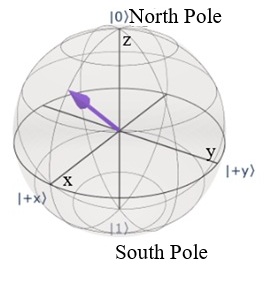
How is the mysterious superposition of quantum states achieved? The answer is: besides "annealing," other techniques use a Hadamard Gate (also called an H Gate). In the theory of quantum computing, there is a sphere called the "Bloch Sphere" (Figure 4) that helps explain the operation of "quantum superposition." This "Bloch Sphere" is just an ordinary sphere, with its center at the origin of the XYZ axes. The Z-axis is the line connecting the North and South Poles. On the "Bloch Sphere," |0> is at the North Pole, and |1> is at the South Pole. In traditional computers, a bit's state is either 0 or 1; there is no "superposition state." "Quantum computers" are different. They have "superposition states." And this "superposition state" is achieved using H gates. The H Gate itself is actually an 180° rotation, and the axis of rotation is the 45° line on the xz plane of the "Bloch Sphere" (the purple axis in Figure 4). Manipulating the |0> at the North Pole with an H-gate will rotate it 180° to the point where the Bloch sphere intersects the +X-axis. This is a superposition state where |0> and |1> each have 50%. Similarly, manipulating the |1> at the South Pole with an H-gate will rotate it 180° to the point where the Bloch sphere intersects the -X-axis. This is also a superposition state where |0> and |1> each have 50%, but of a different type. In fact, apart from the North and South Poles, every point on the Bloch sphere is a quantum superposition state. So, what technology is used to achieve this 180-degree rotation with an H-gate? Superconducting H-gates use nanosecond-level microwave pulses to stimulate the electric dipole of their superconducting qubit. Ion-trap technology uses two laser beams to drive their positive ion qubit to different energy states. The "photon" technology uses a 50/50 beam splitter to split incident photons into two paths with equal probability, achieving the function of an H-gate. The "neutral atom" technology uses laser pulses of fixed frequency with varying pulses to irradiate neutral atoms. The "topology" technology utilizes the weaving of superconducting nanowires. As for "annealing," it doesn't use an H-gate; its computer processor is placed in a cryogenic chamber (only 0.015 kelvin above absolute zero). Thousands of independent superconducting circuits, approximately 10 micrometers in diameter each, are fabricated on the computer's chip as "qubits." Each circuit is independently controlled by tiny currents on the chip, which generate precisely calibrated magnetic flux. To achieve a quantum superposition state, a suitable transverse magnetic field is applied to the circuit.
Why is it so difficult to build a quantum computer with millions of qubits?The fragility of qubits – Due to their interaction with the environment (e.g., thermal noise, electromagnetic interference), qubits are inherently unstable, leading to decoherence, where quantum information is lost within milliseconds or less. Maintaining millions of qubits working requires extremely high isolation environments, such as near-absolute zero temperatures or extremely high vacuum, which is very difficult. Error rate – Each logic gate in a quantum system has an error rate of 0.1-1%, necessitating error correction codes. These codes require thousands to tens of thousands of physical qubits. A system with thousands of "logic qubits" may require millions of physical qubits for error correction, and these millions of physical qubits must all function correctly. Complexity of control electronics and circuitry – Each qubit requires individual control for initialization, operation, and readout, typically achieved through "microwave pulses" or "lasers." As the number of qubits increases, the complexity of the circuitry and electronic components also surges, leading to crosstalk, heat dissipation problems, and calibration difficulties. Current systems already place enormous strain on cryogenic devices with thousands of lines; scaling to millions of lines may require breakthroughs in integrated control chips or optical addressing, due to the sheer complexity of the circuitry. Manufacturing and material limitations—producing millions of identical high-fidelity qubits is an immense challenge for manufacturing. Can anyone say it is easy to produce millions of completely identical qubits?
Are quantum computers difficult to understand? ?Absolutely; it doesn't follow our everyday intuition, but rather the complex principles of quantum mechanics found in the microscopic world. Traditional computers use only "0" or "1" bits, and each operation can be understood using general logic. However, the qubits of a quantum computer can exist in a superposition of "0" and "1," and can even exhibit entanglement—a phenomenon that baffled Einstein, who called it "spooky action at a distance"—using "interference" to enhance correct answers and cancel out incorrect ones. Even more challenging is that quantum states change once measured, and quantum algorithms, such as Grover, Shor, and annealing, often don't calculate the answer step-by-step, but rather cleverly design the evolution of quantum states to maximize the probability of obtaining the correct answer during the final measurement. These concepts are vastly different from the motion and causal relationships we observe daily. Furthermore, understanding the mathematics required for a quantum computer is far more difficult than understanding the mathematics required for a traditional computer. These factors alone are enough to make quantum computing one of the most difficult fields of modern technology to understand. However, based on past experience, humans are indeed a species that learn very quickly and possess a strong ability to adapt. Just as we quickly became accustomed to traditional computers and mobile phones, once quantum computers become widespread, the public will inevitably be able to understand their principles, become familiar with their operation, and integrate them into their daily lives in a short period of time.
Conclusion: The emerging technology of quantum computing has the potential to become another major driving force for transforming human civilization, following traditional computers and artificial intelligence. While it cannot replace traditional computers, in specific areas such as cracking encryption, new drug development, new material design, accelerating AI progress, financial analysis, logistics optimization, and scientific simulation, it has the potential to deliver unprecedented computing power, solving problems that would currently require millions of years or even be impossible for supercomputers to solve. In the future technological arena, quantum computers, traditional computers, and AI will each display their unique strengths! When they work together in medicine, communications, and basic science, human life could undergo a profound transformation, directly ushering in an unimaginable "quantum new era"! (2026-07-11 New Jersey).