In ancient times, astronomical omens were considered to be the will of heaven and possessed extraordinary power. In the 14th chapter of the Three Kingdoms Romance (三國演義) written by Luo Guanzhong (羅貫中), “Cao Mengde (曹孟德) moved his imperial court to Xudu(許都), and Lü Fengxian (呂奉先) attacked Xujun (徐郡) at night”, it was mentioned that Cao Cao (曹操) had the ambition to wear the imperial robe himself, and it would be best if there was an astronomical phenomenon to prove that this was the will of heaven. So there was a description of astronomical phenomena – “Cao discussed the matter of moving the capital with his advisers on that day. At that time, the Minister of the Court and the Grand Historian Wang Li (王立) privately told the Minister of the Imperial Clan Liu Ai (劉艾): “I looked up at the sky and found that since last spring, Venus has violated Saturn in the region of Sagittarius and Capricorn and passed Deneb (天津星). Mars is also retrograde and will meet Venus in the direction of Zeta Tau star (天關星). When gold (referring to Venus) and fire (referring to Mars) meet, a new emperor will surely appear. I see that the fate of the Han Dynasty will end, and the land of Jin (晉) and Wei (魏) will surely rise. (Note: The five planets, Mercury, Venus, Mars, Jupiter and Saturn, are respectively called Chenxing (辰星), Taibai (太白), Yinghuo (熒惑), Suixing (歲星), and Zhenxing (鎮星) in ancient Chinese historical records). Luo Guanzhong (羅貫中) wrote a chapter novel, so the time of astronomical phenomena is not accurate enough. It just so happens that Zhang Fan’s (張璠) “Chronicle of the Later Han Dynasty” also has a similar record in the chapter “Chronicle of Emperor Xian (獻帝)”. The result of the verification is that the Grand Historian Wang Li (王立) said that the time when I looked up at the sky was the first year of Jian’an (建安) (i.e., AD 196). The last spring described in “Last spring, Venus offended Saturn” was the spring of AD 195. Then Luo Guanzhong (羅貫中) continued to write that “Meeting Venus at Zeta Tau star (天關星), Venus and Mars met” seemed to have happened in AD 195, but after checking with the author’s “Calculation of the Right Ascension of the Seven Planets in Ancient and Modern Times” (Note: Right Ascension is the longitude of the equator), there was no “Mars and Venus met at Zeta Tau ” in AD 195. Here we will describe the use of astronomical calculations of “The Right ascension of the Seven Planets in Ancient and Modern Times” to verify the astronomical phenomenon of the Han and Wei dynasties in the Three Kingdoms Romance (三國演義), and then verify the astronomical wonder of the Seven Luminaries in the Same Palace (七曜同宮) and Five Planets in a Row (五星連珠) in May 2000, and when the next astronomical wonder of same will occur.
To observe the movement of the planets in the solar system, it is best to jump out of the solar system to see clearly: standing outside the solar system to observe, you can see that the eight planets are all orbiting the sun in a nearly circular orbit, and the moon is orbiting the earth in a nearly circular orbit. But for us humans living on Earth, it is certainly not easy to go outside the solar system, so the best observation point is on the surface of our own Earth. This is exactly the same as the ancient people’s observation of celestial phenomena: the celestial bodies in the universe are all moving on the celestial sphere. Although the celestial phenomena on the celestial sphere in the night sky of each season are different, the celestial phenomena in the spring night sky every year are almost exactly the same. The only things that change are the Moon and Mercury, Venus, Mars, Jupiter, and Saturn (Uranus and Neptune were discovered later). In addition to the Moon, these planets sometimes go retrograde. In fact, the Greek astronomer Ptolemy in the second century BC once proposed a hypothesis that all celestial bodies, including the Sun, Moon, planets, and more distant stars, revolve around the earth as the center. In the following thousand years, This “geocentric theory” is the human understanding of the entire universe. Later, some people gradually realized that the Sun is the center of the universe, which is the heliocentric theory. Of course, we now know that the sun is just an inconspicuous star in the rotating arm of the Milky Way. But then again, we who live on Earth still view the entire universe from the perspective of the Earth. The first step in our astronomical calculations is of course to use the Sun as the center of the orbits of each planet, and then parallel-shift the obtained data to our Earth, which becomes the data of the planets on the celestial sphere and the movement of the Sun and the Moon from our Earth.
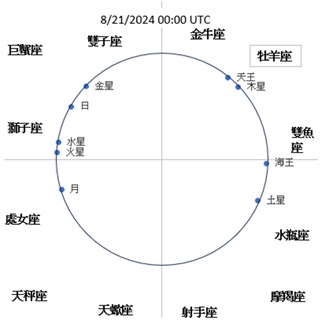
The circle in Figure 1 is the celestial sphere (one circle is 360 degrees of Right Ascension), the Earth is at the center of the circle, and the Sun, the Moon and the seven planets all revolve around the earth on the circle. This figure is the results of the calculation for the positions on the celestial sphere of these nine celestial bodies when 8/21/2024 is entered as the date in the astronomical calculation program. Figure 1 also marks the positions of the 12 constellations for comparison. Enter any date in the late Han Dynasty and the date of the Three Kingdoms Romance (三國演義) period to find out the positions of these nine celestial bodies on the celestial sphere on that day. The astronomical calculation program also has a designated key (on the keyboard), and once you press it, the date will automatically jump one day, In this way, you can see the movement of each celestial body, such as which planet is moving in the normal direction, which is in “retrograde”, and which two planets overlap (called “violation” in ancient times, for example: Venus violates Saturn), etc. The program also has a Do-Loop, which can be used to watch the movement of the nine celestial bodies as a whole, or a group of celestial bodies, for a week, a month, a year, a decade, or a hundred years, just like a movie. It is the easiest to use this celestial body calculation program to verify the accuracy of the ancient description of celestial phenomena.
Astronomical phenomena on the fate of Han (漢) and Wei (魏) in the Three Kingdoms Romance (三國演義) — Using this astronomical calculation program, and applying it to AD 195 and AD 196 (the first year of Jian’an (建安) in the Eastern Han Dynasty (東漢) was AD 196), the author obtained the following data: On 2/10/195, Venus violated Saturn at Right Ascension 287o. On 3/1/195, Venus passed Deneb. From 1/6/195 to 3/26/195, Mars was in retrograde motion. On 3/26/195, it reached Right Ascension 137o, and was able to stay at Pollux at Right Ascension 116o. As for “Tianguan (天關)” (i.e. Zeta Tauri, at right ascension 84o, Taurus), Mars only moved to Right Ascension 297o at the end of AD 195, which was still a long way from the position of Tianguan (天關) star at Right Ascension 84o. Therefore, “Meeting with Venus at Tianguan; the conjunction of Venus and Mars” did not happen in AD 195, but was the astronomical phenomenon in AD 196. In AD 196, Venus and Mars conjuncted twice; once on 4/17/196, at Right Ascension 18o, when Venus was still in retrograde, and the other time on 8/19/196, at Right Ascension 107o. These two conjunct points were not very close to the Right Ascension of 84o in Tianguan. It can be said that Venus and Mars were near Tianguan on 7/26/196, one (Venus) at Right Ascension 78o and the other at Right Ascension 90o. But then again, the intention of the historian Wang Li (王立) was to talk about the conjunction of Venus and Mars. According to this astronomical phenomenon, war broke out, which was a sign of revolution, and the Han Dynasty was doomed. As for where the two planets conjuncted, it may not be important.
Seven Luminaries in the Same Palace (七曜同宮) and Five Planets in a Row (五星連珠) — 古人所講的七曜,就是The seven luminaries mentioned by the ancients are the seven shining celestial bodies in the sky, namely the Sun, Moon, Mercury, Venus, Mars, Jupiter and Saturn. The celestial sphere has a circle of 360 degrees, with a total of twelve palaces (宮), each occupying 30 degrees. When we say “staying at the same palace”, we mean that the distribution of these celestial bodies is limited to a range of 30 degrees. The five planets mentioned by the ancients are Mercury, Venus, Mars, Jupiter and Saturn. The five planets in a row means that these five planets seem to be connected together (i.e., in conjuction) when viewed from the Earth. When the five planets are squeezed the tightest, the sun and the moon may not be nearby. Therefore, the days when the seven luminaries are in the same palace and the days when the five planets are in a row may be different. The author used this astronomical calculation program which was designed to search for whether the seven luminaries in the same palace or the five planets in a row occurred in the 50 years from 2000 to 2050. The result found that after these phenomena appeared once in May 2000, it will not appear again until 2040.
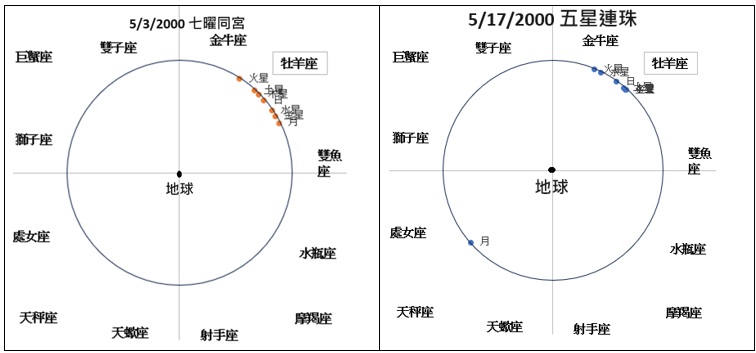
Figure 2a shows the phenomenon of the seven celestial bodies in the same palace on 5/3/2000. On that day, the seven celestial bodies — the Sun, Moon, Mercury, Venus, Mars, Jupiter and Saturn, were squeezed into a narrow 25.7-degree angle in Aries. Two weeks later, on 5/17/2000, the five planets, Mercury, Venus, Mars, Jupite and Saturn, were even closer (the phenomenon of the five planets in a row), squeezed into a narrow 20.1-degree area in Aries (although the Sun was still squeezed in, the Moon had already moved to 221o of Right Ascension), as shown in Figure 2b.
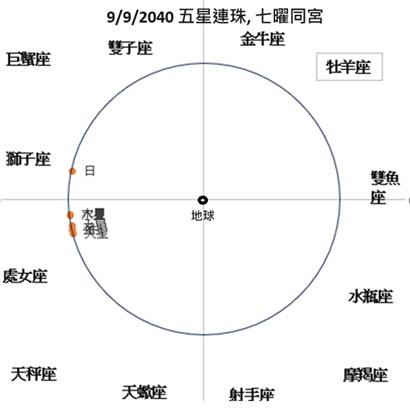
Seven Luminaries in the Same Palace and Five Planets in a Row of September 2040 — Figure 3 shows the phenomenon of the five planets in conjunction and the seven celestial bodies in the same palace on 9/9/2040. On this day, the seven celestial bodies, the Sun, the Moon, Mercury, Venus, Mars, Jupiter and Saturn, squeezed into the narrow 26.9-degree angular distance of Virgo. If the Sun is removed, the five planets are even closer (the Moon also happens to be squeezed in), and their angular distance is a very small 8.3 degrees. Think about it carefully, the five planets are usually broadly distributed on the Right Ascension of a circle of 360 degrees, and it is so rare to have such a day to squeeze within 10 degrees. This is a rare astronomical wonder that only happens once in 500 years (2000-2500)!
Conclusion: Although human beings are small, they have enough wisdom to explore the vast universe and astronomy. The first step into the universe is our solar system. Ancient people must also be very smart, but due to the lack of instruments or the use of crude instruments, they can only do limited astronomical observations. In the sky, the Sun and the Moon are big and bright. They are the most observed. For the five planets of Mercury, Venus, Mars, Jupiter and Saturn, ancient people were also diligent in taking notes when they were observed, recording the trajectory of each day and each hour. “Astronomical archaeology” has also become a hobby for many retired people, including the author. Now the Internet is so popular, the knowledge that can be accessed is so abundant, and the computing power of home computers is so fast, it is really easy for modern people to do some of the work of ancient astronomers. This article briefly introduces the astronomical calculation program I developed and applied it to the astronomical observations recorded in the Three Kingdoms Romance (三國演義), and introduces the astronomical wonders of the Five Planets in a Row (五星連珠) and the Seven Luminaries in the Same Palace (七曜同宮) to share with readers. (2025-05-30 New Jersey).