The written history of Taiwan is mostly about the things happened within the past 400 years that were recorded in written texts. But the history of Taiwan's inhabited people is not just 400 years. Taiwan's aborigines came to Taiwan tens of thousands of years ago to cultivate and work hard. Taiwan's Changbin (長濱文化), Beinan culture (卑南文化), and Dazakeng culture (大坌坑文化) all have aboriginal cultural relics. From a narrow perspective, most people believe that the history of an area begins after someone moves in the area. But history, basically speaking, is a true description of the past. Including people, things or things in the past. Since people and things exist in the universe, strictly speaking, their pasts can be connected by the umbilical cord and traced back to the very beginning of the universe. Although all the mass and energy that make up the land of Taiwan already existed in the quantum vacuum (Quantum Fluctuation) of the big bang 13.8 billion years ago, Taiwan had not yet been formed at that time. It would have to wait until the birth of the Milky Way galaxy 13 billion years ago. Then there were the birth of the solar system 4.6 billion years ago and the birth of the earth 4.5 billion years ago. Only then can we talk about the land masses on the earth and the birth of Taiwan as an island 5 million years ago.
Evolution of Earth and the Birth of Taiwan
When the Earth was first formed, the surface temperature exceeded 4,000 degrees Celsius; the atmosphere contained no oxygen and no water. Later, the temperature slowly dropped, and by 4 billion years ago, the average temperature of the earth dropped to probably 68 degrees Celsius, which was still quite hot. The atmosphere was mostly nitrogen and methane, with little oxygen. Many icy comets, meteorites, and asteroids from outer space also hit the newly born earth, bringing ice with them. The ice entered the high-temperature earth. So there were oceans and living things around 4 billion years ago. By 2.8 billion years ago, the average temperature of the earth was about 10 degrees Celsius, which was very cold. Later, by 2.7 billion years ago, it returned to around 16 degrees Celsius.
Photosynthetic organisms caused the amount of oxygen in Earth's atmosphere to begin increasing. As oxygen accumulated, iron on Earth's surface and dissolved iron in the oceans gradually became oxidized. During this process, the oceans are thought to have appeared reddish for a period of time because of the oxidation of dissolved iron. During Earth's 4.5-billion-year history, the continents have gone through several cycles of assembling into supercontinents and then breaking apart. The most recent supercontinent, Pangaea, existed more than 200 million years ago, when nearly all of Earth's landmasses were joined together into one enormous continent. Pangaea later broke apart, and its fragments gradually drifted to form today's continents and tectonic plates. Today, the Eurasian continent lies primarily on the Eurasian Plate. Other major tectonic plates include the Philippine Sea Plate, Australian Plate, Pacific Plate, North American Plate, African Plate, Arabian Plate, and Indian Plate, among others. Because tectonic plates are constantly moving, collisions and friction between them are inevitable. For example, the Philippine Sea Plate is moving northwestward at a rate of about 7 centimeters (3 inches) per year relative to the Eurasian Plate. The ongoing collision between these plates, together with the uplift caused by compression and the long-term effects of earthquakes and volcanic activity along their boundary, gradually raised Taiwan above sea level. By about 5 million years ago, Taiwan had begun to take on much of its present-day form.
The arrival of Taiwan's indigenous people
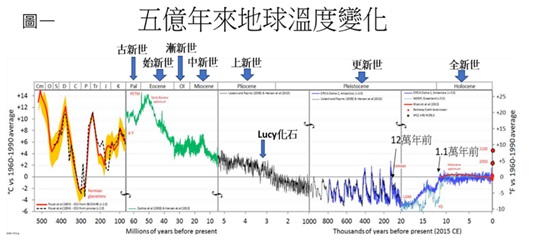
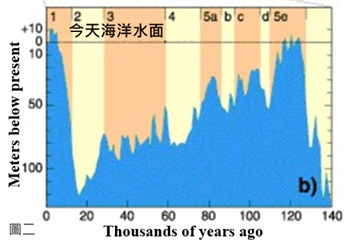
Lucy, one of the best-known early human ancestors (Australopithecus afarensis), lived about 3.2 million years ago. Her fossilized remains were discovered in Ethiopia in 1974. When Lucy was alive, the global average temperature (see Figure 1) is estimated to have been about 65°F (18°C), roughly 5°F (3°C) warmer than today. Global temperatures continued to decline over time. By about 1 million years ago, the global average temperature was approximately 55°F (13°C), about 5°F (3°C) cooler than today, and Earth experienced repeated glacial (ice age) cycles. Homo sapiens first appeared in Africa about 300,000 years ago, during the Ice Age. Beginning around 200,000 years ago, some early modern humans gradually dispersed out of Africa. Many followed relatively warm routes, generally closer to the equator, into Eurasia. One migration route toward present-day Indonesia is thought to have passed through the Arabian Peninsula, Iran, Pakistan, India, and mainland Southeast Asia before reaching the Indonesian archipelago. During the Last Glacial Period (LGP), which lasted from about 120,000 to 12,000 years ago, global temperatures continued to fall. Around 20,000 years ago, near the Last Glacial Maximum, the global average temperature was about 50°F (10°C), approximately 10°F (6°C) cooler than today. Because of the prolonged cold climate, more snow accumulated each winter than melted during the summer. Over thousands of years, large ice sheets expanded from the polar regions toward lower latitudes, storing enormous amounts of water on land. As a result, global sea levels gradually fell. During the later part of the Last Glacial Period—roughly 30,000 to 15,000 years ago—sea level was more than 100 meters (330 feet) lower than it is today (see Figure 2). As a result, the Taiwan Strait and large portions of the continental shelves connecting mainland Southeast Asia with the islands of present-day Indonesia were exposed as dry land for many thousands of years. Taiwan was connected by land to the Asian mainland, making it possible to travel there on foot. For this reason, some researchers propose that during the Late Paleolithic, more than 30,000 years ago, prehistoric people from what is now southern China and mainland Southeast Asia were able to reach Taiwan over land, without crossing the sea. According to this hypothesis, they became some of Taiwan's earliest inhabitants. Later waves of Indigenous peoples, arriving around 6,000 years ago after sea levels had risen again, would have reached Taiwan by sea and brought well-developed boat-building and seafaring skills.
The indigenous people of Taiwan may be the ancestors of Austronesian peoples.
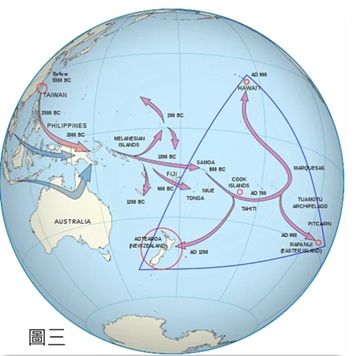
Human activity on the island of Taiwan has a history of more than four hundred years—according to archaeological evidence, this history spans the Late Paleolithic, Neolithic, and Iron Ages, lasting at least thirty thousand years. The Baxiandong Changbin Culture (八仙洞長濱文化) unearthed in Taiwan dates back tens of thousands of years. The Dapenkeng Culture (大坌坑文化) dates back 6,000 years. The Puyuma Culture (卑南文化) dates back 5,000 years. Taiwan's indigenous peoples developed unique agriculture, pottery, culture, and distinctive languages, establishing themselves as a model for the vast Austronesian language family. Just like the Dutch and Spanish, with their advanced seafaring skills 400-500 years ago, Taiwan's indigenous peoples, tens of thousands years ago, also expanded overseas due to their superior seafaring skills (see Figure 3). 4,000-5,000 years ago, they spreaded south from Taiwan to the northern Philippines. More than 3,000 years ago, they spreaded from the Philippines to Indonesia, Malaysia, and Timor. More than 2,000 years ago, they spreaded west to Madagascar in Africa and east to Polynesia and many islands in the Pacific. How ancient humans, carrying blood and language, spreaded out is a subject of great interest for many modern DNA archaeologists and linguists. According to linguists, there are now more than 200 language families worldwide, all with histories spanning 5,000-6,000 years to tens of thousands of years. There are five language families with over 500 million speakers: Indo-European (3.5 billion speakers, originating in Ukraine and southern Russia; English is derived from this family), Sino-Tibetan (1.4 billion speakers, Yellow River basin), Niger-Congo (700 million speakers, West Africa), Austronesian (600 million speakers, Taiwan), and Afro-Asian (500 million speakers, Sudan and Ethiopia). The languages of Taiwan's indigenous peoples are now widely recognized by linguists as the origin of the Austronesian language family (comprising 10 branches and over 1000 languages). Austronesian peoples include Taiwanese indigenous peoples, as well as people from the Philippines, Indonesia, Vietnam, Thailand, Cambodia, Laos, Pedro, Sarawak, Malaysia, New Zealand, Madagascar in Africa, and the entire South Pacific. Besides linguistic similarities, DNA analysis has also revealed that the mitochondrial haplogroups of Austronesian peoples can be traced back to the indigenous peoples of Taiwan.
Han Chinese migration to Taiwan
Taiwan's aboriginal people have different ethnic groups, including the Amis(阿美族), Atayal(泰雅族), Bunun(布農族), Tsou(鄒族), Paiwan(排灣族), Puinan(卑南族), Rukai(魯凱族), Gemalan(葛瑪蘭族, Yami(雅美族), Saisiyat(賽夏族), Seediq(賽德克族), La'aluwa(拉阿魯哇族), Sakilayah(撒奇萊雅族), Kanakanafu(卡那卡那富族), Siraya(西拉雅族), Pingpu(平埔族), etc. Tribes often kill each other and often cut off the heads of their enemies and hanged them on the door. From the Qin (秦) Dynasty to the Yuan(元) Dynasty, Han people had no need and did not dare to immigrate to Taiwan where people were beheaded to settle. Pirates or fishermen would temporarily settle down. Due to the maritime ban policy, the Ming(明) Dynasty regarded Taiwan as a desert island in the sea, and no one dared to come to Taiwan. The pirate Yan Siqi(顏思齊), in 1624 (late Ming Dynasty), was imprisoned in Japan. He was exiled from Japan to Chiayi, Taiwan where he developed a base. He went to Fujian to recruit immigrants and introduce advanced production technology and tools. He died of illness in 1625, and was taken over by the 22-year-old pirate Zheng Zhilong(鄭芝龍), who became even more powerful. Even the Ming Dynasty was afraid of him and could not pacify his group. Later, the Ming Dynasty resorted to the last resort, and the governor of Fujian (福建) recruited Zheng Zhilong, gave him an official position, and made him submit. In the late 1620s, a serious drought occurred in the Fujian area, and the people were unable to survive and starved to death everywhere. Zheng Zhilong had more than 30,000 troops and more than a thousand ships, so he suggested that the governor provide official subsidies so that he could lead tens of thousands of hungry people from Quanzhou(泉州) to Taiwan to reclaim land. At this time, although the Dutch claimed to be governing Taiwan (actually they wanted to do business and missionary work), due to the small number of people in the Dutch East India Company and the need to deal with the aboriginal people, the Dutch ruling power was only in southern Taiwan (near Tainan台南). In northern Taiwan, there was Spanish power; Spain occupied Keelung (基隆) and Tamsui (淡水) in 1626 (they were expelled from Taiwan by the Dutch in 1642), and they did not have many troops. In the 1620s, neither of them could afford to offend Zheng Zhilong's power. Later, Emperor Chongzhen (崇禎皇帝) committed suicide in 1644, and Zheng Zhilong did not listen to the advice of his son, Zheng Chenggong (鄭成功), and led the top general Shi Lang (施琅) to surrender to the Qing Dynasty (清朝) in 1646. Zheng Chenggong continued to resist the Qing Dynasty and restore the Ming Dynasty along the coast, but was later defeated by the Qing Dynasty and had to move his position. He led more than 20,000 people to attack Taiwan and defeated the Dutch in 1661 (Note: The Dutch were in dire situation in those years, and the Manhattan they occupied was defeated by the British three years later in 1664, and was renamed "New York" ), establishing the Ming-Zheng Dynasty (明鄭王朝) in Taiwan, and Han (漢) immigrants increased. The Ming-Zheng Dynasty went through five kings, and they were defeated in 1683 by Shi Lang of the Qing Dynasty. Zheng Keshuang (鄭克塽, grandson of Zheng Chenggong 鄭成功) surrendered, and the Ming-Zheng Dynasty lasted for only 22 years. While the Qing Dynasty destroyed the Ming-Zheng Dynasty, the emperor and his advisers had different opinions on how to dispose Taiwan. Some advisers said that "Han people should be moved back and the land of Taiwan abandoned", while others said that "it is useless to keep it, but it is harmful to abandon it." However, Shi Lang insisted on taking back Taiwan to prevent foreign pirates from causing chaos and causing trouble to the southeastern provinces. After 10 months of quarreling, Kangxi (康熙) followed Shi Lang's suggestion to take back the territory and set up Taiwan Prefecture, which was subordinate to Fujian Province. Although the sea ban policy was lifted, a ban on crossing Taiwan was issued. Anyone crossing Taiwan must be reviewed by the government and are not allowed to bring their families. Therefore, although there are various conflicts between the Han people and the aborigines in Taiwan for agricultural development and competition for survival, intermarriage is also common since Han girls are scarce. In the eyes of the Qing Dynasty, the governance of Hebei (河北), Shanxi (山西) and other Central Plains areas was the most important. After all, Taiwan was a desert island isolated overseas and infested with barbarians and bandits. In more than 200 years after it was reclaimed, the attitude of the Qing Dynasty was like "we do not have resources for the development of Taiwan, but just pray that public security is maintained and the island won't become a piracy war zone or that aboriginals resist the Qing Dynasty; it would be extremly fortunate if there is no Fujian-Guangdong Fight (閩粵鬥) or Zhangquan Fight (漳泉拚) among the Han people". Therefore, it was only until 1885 that Qing Dynasty became pro-active and established Taiwan as a province. However, nine years later, the Sino-Japanese War of 1894-1895 occurred. The Qing Dynasty was defeated and the Qing Dynasty had to cede territory to seek peace. Once the requirement of "ceding territory" was on the table, the desert island of Taiwan was put on the front. In 1895, Li Hongzhang (李鴻章) signed the Treaty of Shimonoseki (馬關條約) on behalf of the Qing Dynasty, and ceded Taiwan to Japan. Japan ruled it for 50 years, which ended when Japan surrendered to the Allies in 1945. The number of Han people in Taiwan increased from 20,000 in 1630 during the Dutch rule, to 33,000 in 1683 at the beginning of the Qing rule, and 37,000 in 1711. There were 1.94 million people in 1811, more than 2.54 million people in 1894, 2.7 million in 1902 at the beginning of the Japanese colonial period, and 6.27 million people in 1944 at the end of the Japanese colonial period. After Japan was defeated and evacuated from Taiwan in 1945, the Nationalist government brought more than 2 million people to Taiwan to take over. By 1956, after the war, Taiwan's Han population reached 9.4 million. Today, Taiwan's total population is 23 million. It is hard to tell how many of them are Han and how many are Aboriginal. According to blood DNA research, 85% of the Hoklo (河洛, 閩南) and Hakka (客家) people in Taiwan today have Aboriginal ancestry. This high degree of blood mixing is not unexpected, because over the past 400 years, Han people have immigrated to Taiwan, and after more than 20 generations of intermarriage, few can retain pure Han or pure Aboriginal blood. The blood mixing is also like this all over the world, whether in Europe or America.
The face of Taiwanese society
History can be approached from different angles. Numerous books cover Taiwan's 400-year history, readily available online. Due to space limitations, this article will not elaborate further, but will only discuss the changes in Taiwanese society. Twenty thousand years ago, the Earth was in its last Ice Age, with continental ice sheets moving south from the Arctic, extending to 37 degrees North latitude (Note: at that time, the ice thickness in the Chicago area at 42o latitude reached 3000 feet). Taiwan, located at approximately 23 o latitude, was not covered by ice, but one can imagine that its indigenous people, like people in other parts of the world, were struggling against nature. Furthermore, conflicts frequently arose among the indigenous populations due to competition for resources. Later, global warming and rising sea levels flooded the Taiwan Strait, leading to increased piracy and numerous conflicts with pirates. In the 17th century, the invasions and establishment of regimes by the Spanish, Dutch, Zheng Chenggong(鄭成功), and the Qing Dynasty (清朝) inevitably resulted in various forms of resistance and conflict. However, like other parts of the world, intermarriage, blood ties, and living together on the same land have shaped a collective consciousness. While indigenous peoples have their own languages, they learned Japanese under Japanese rule, and Taiwanese Mandarin and local dialects like Taiwanese dialect or Hakka dialect under the Nationalist government. Everyone, regardless of bloodline, is busy adapting to the challenges of social change and progress, seeking a way to live a peaceful and prosperous life. Taiwan has its own unique historical trajectory and experiences. Many older people have personally experienced the most significant historical trajectory and experiences that have influenced Taiwan over the past 80 years, so I won't elaborate further. These experiences reflect the face of Taiwan today: a democratic, rule-of-law-based, free, diverse, open, inclusive, culinary-loving, peace-loving, vibrant, internationally-minded, trade-oriented, and humane island where people frequently use polite phrases like "excuse me."(不好意思).
(2024-10-11 New Jersey).